
How To
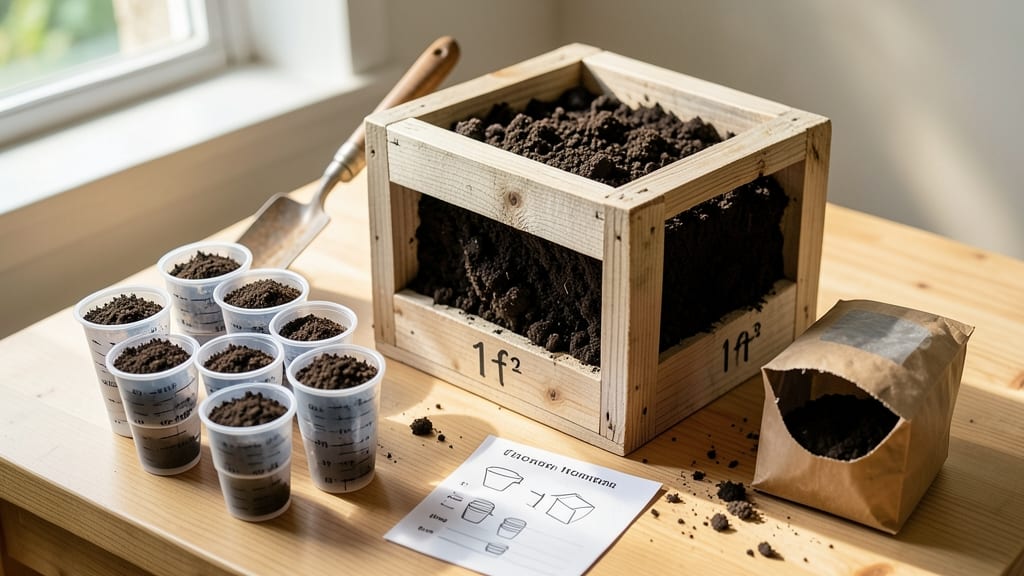
Converting 25 quarts of soil to cubic feet equals approximately 0.72 cubic feet, a precise measurement that's essential for accurate gardening projects, potting mixes, and raised bed calculations. This ratio helps maintain consistency in planting volumes and container sizing.
Understanding this conversion is all about how soil volume translates between different measurement systems. 🌱 A cubic foot represents a three-dimensional space (12 inches × 12 inches × 12 inches), while quarts measure liquid capacity—though soil's bulk density (how tightly packed it is) affects the actual weight and volume.
For example, sandy soil weighs less per cubic foot than clay-heavy mixes because sand particles pack less tightly. When working with raised beds, this means your 25-quart bag might fill less than 0.72 cubic feet if the soil is compacted, while loose compost could exceed that volume slightly.
Always account for moisture too—wet soil takes up less space than dry.
This conversion becomes especially useful when scaling up projects. Need to fill a 4'×2'×1' raised bed? That's 8 cubic feet, so you'd need about 11 bags of 25-quart soil (11 × 0.72 = 7.92 cubic feet).
For potting mixes, knowing this ratio helps you blend components like peat moss or perlite accurately. Pro tip: Use a measuring tape for container dimensions and multiply length × width × height to calculate cubic feet before buying soil.
💡 In This Article
- How Soil Volume Conversions Work for Gardening
- Practical Uses for 25-Quart Soil Measurements
How soil volume conversions work for gardening
At its core, converting 25 quarts of soil to cubic feet relies on understanding how three-dimensional space translates to liquid volume measurements. A cubic foot is a perfect cube measuring 12 inches on each side, giving it a total volume of 1,728 cubic inches.
Since 1 quart equals 57.75 cubic inches, 25 quarts would theoretically occupy 1,443.75 cubic inches—about 83% of a cubic foot. However, soil isn't a perfect liquid; its bulk density (how tightly particles pack) alters this ratio.
The key factor is particle size and composition. Sandy soil, with its loose, coarse particles, has a bulk density of roughly 100-120 pounds per cubic foot, while clay-heavy mixes can reach 150+ pounds per cubic foot due to tighter packing.
This means your 25-quart bag of sandy soil might actually fill closer to 0.8 cubic feet when loose, while compacted clay soil could occupy just 0.65 cubic feet. Moisture content further complicates things—wet soil compresses, reducing volume by up to 10-15% compared to dry soil. 🌱
For precise gardening, this translates directly to project planning. Imagine filling a 3'×1'×1' raised bed (3 cubic feet). Using the 0.72 cubic feet per 25-quart ratio, you'd need about 4 bags of soil.
But if your mix is 20% heavier due to clay content, you might need 5 bags to account for compaction. Always test your soil's settling behavior—fill a container, tamp it down, then measure the reduced volume to adjust calculations.
Here's the math behind the conversion:
- 1 cubic foot = 29.92 quarts (theoretical liquid volume)
- 25 quarts ÷ 29.92 ≈ 0.835 cubic feet (dry, loose soil)
- Adjust for density: Clay-heavy mixes → 0.65-0.75 cubic feet; Sandy mixes → 0.8-0.9 cubic feet
Professional gardeners use this principle to create consistent soil blends. For example, a 50/50 peat-perlite mix will have a different cubic-foot-to-quart ratio than straight topsoil because perlite's lightweight particles increase total volume while reducing weight. Always account for these variations when scaling recipes for large projects. ✨
For visual learners, think of a 12"×12"×12" cube (1 cubic foot). If you fill it with 25 quarts of potting mix, you'll see about 3 inches of empty space at the top—this gap represents the difference between liquid volume and bulk soil density.
This "headspace" is why gardeners often overestimate how much soil they need without proper conversions.