
Light Requirements
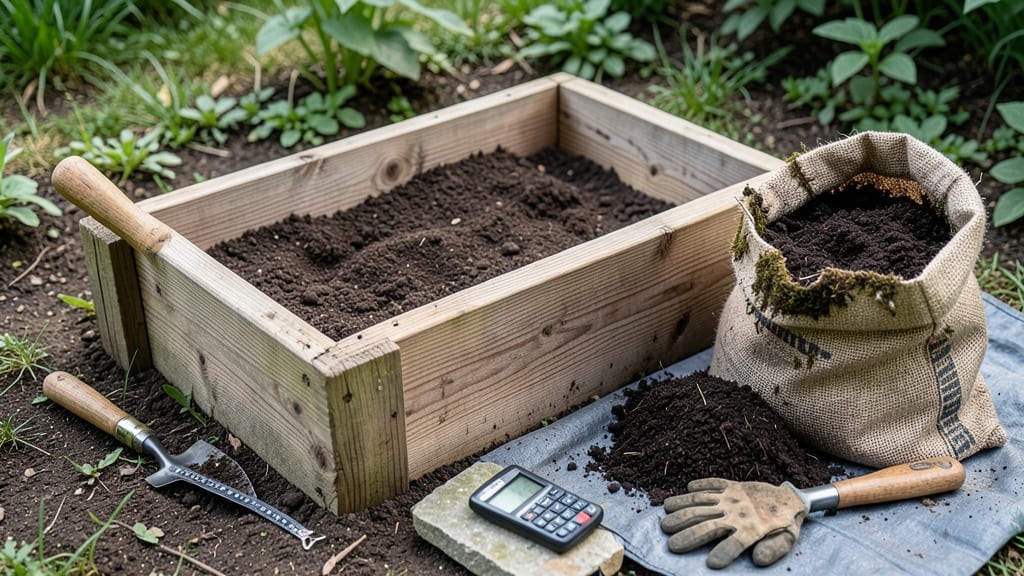
To determine how much soil you need for a raised garden bed, multiply its length by width by depth (in feet) to get cubic feet, then convert to cubic yards or bags. For example, a 4’x8’ bed filled 12” deep requires 3.33 cubic yards of soil.
Calculating the right amount of soil prevents wasted money and ensures your plants thrive. The key is working in feet—not inches—because most soil bags list coverage in cubic feet. For instance, a 4’x4’ bed filled 12” deep needs just 1.33 cubic yards, while deeper beds or wider layouts jump significantly.
I always round up to account for settling, which can reduce volume by 10-15% after watering. 🌱
Once you’ve got your cubic yards, check bag labels: a standard bag covers about 0.5 cubic feet, so 3.33 cubic yards would need roughly 66-70 bags. Pro tip? Mixing 60% topsoil with 40% compost improves drainage and fertility, especially for root crops like carrots or potatoes.
Always test your soil’s moisture retention—too much clay or sand can throw off your calculations entirely.
💡 In This Article
- Calculating Raised Garden Bed Soil Volume: Formula Breakdown
- Best Soil Types and Bag Quantities for Raised Beds
Calculating raised garden bed soil volume: formula breakdown
Understanding the math behind soil volume starts with converting all measurements to feet. A raised bed's soil volume is calculated by multiplying length × width × depth (all in feet).
For example, a 4-foot by 8-foot bed filled 12 inches deep (which is 1 foot) needs 32 cubic feet of soil. This works because 4 × 8 × 1 = 32. The key is consistency—always use feet for accuracy, as soil bags typically list coverage in cubic feet. 🌱
Depth matters more than you might think. A 6-inch (0.5-foot) deep bed for herbs or greens requires half the soil of a 12-inch (1-foot) bed for root vegetables. For instance, that same 4’x8’ bed at 6 inches deep would need only 16 cubic feet.
Most gardeners aim for 12 inches of soil for optimal root growth, but deeper beds (18-24 inches) are ideal for potatoes or tomatoes. The formula scales linearly, so doubling depth doubles the volume.
Bed shape affects calculations too. Rectangular beds are straightforward, but circular or keyhole designs require a different approach. For circles, use the formula π × radius² × depth (radius = half the diameter). A 4-foot diameter circular bed at 12 inches deep needs about 15.1 cubic feet.
Keyhole beds combine straight and curved edges—break them into sections and calculate each separately. Always round up to avoid shortages, as soil settles over time and watering can reduce volume by 10-25%. 💫
Real-world adjustments are critical. Soil bags often list coverage based on loose, fluffy material that compacts when wet. A bag labeled "0.5 cubic feet" may only yield 0.4 cubic feet after settling. For a 4’x8’x12” bed (32 cubic feet), you’d need 64-80 bags to account for this.
Pro tip: Use a tape measure for precise dimensions and a shovel to level the base—uneven beds waste soil and create air pockets that stunt root growth.
Consider the soil's texture too. Sandy soil compacts less than loamy or clay-heavy mixes, so adjust your volume estimates accordingly. For example, a clay-rich blend might settle 20% more than sandy loam.
Always test your soil’s moisture retention—if it clumps when wet, you’ll need more air pockets (like perlite or compost) to maintain structure. This affects not just volume but also drainage and plant health. 🔥
For advanced gardeners, layering soil types can optimize growth. Place nutrient-rich compost at the bottom (6 inches) for roots, then top with lighter, well-draining soil for top growth. This technique reduces total volume needed while improving fertility.
For instance, a layered 12-inch bed might use 4 inches of compost and 8 inches of topsoil, cutting your bag count by 33% compared to uniform filling.