
Landscaping
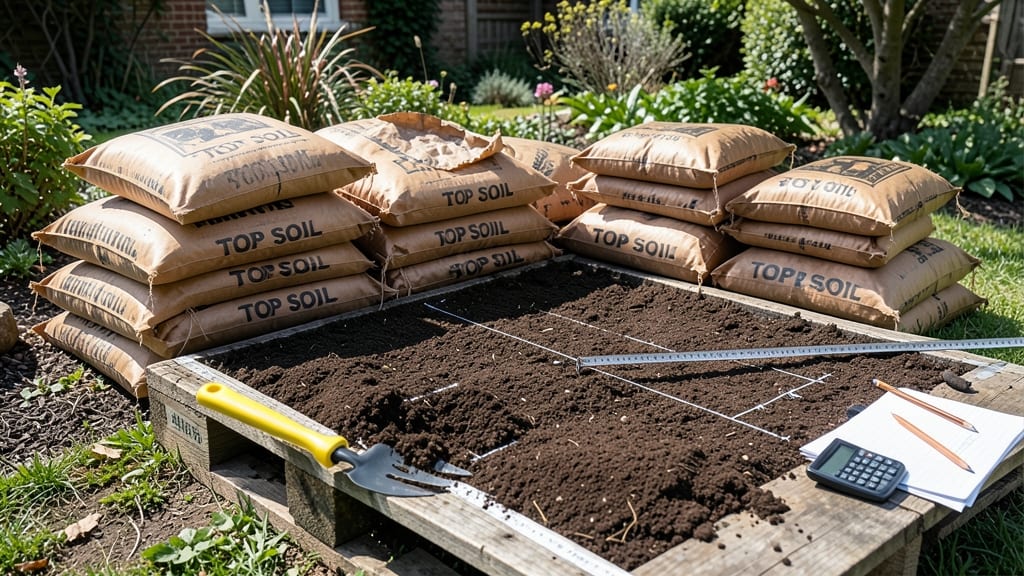
To determine how many 40 lb bags of topsoil are needed per yard, calculate 46 bags for 1 cubic yard of loose topsoil at 1-inch depth, adjusting for depth (e.g., 2 inches = 92 bags). Account for soil compaction by adding 10-20% extra bags for tighter packing or uneven terrain.
Understanding how many 40 lb bags of topsoil fit into a cubic yard is all about volume math.
A single cubic yard equals 27 cubic feet, but topsoil settles differently based on depth—so a 1-inch layer requires 46 bags, while doubling to 2 inches needs 92. 🌱 This calculation assumes loose topsoil, which compacts when spread, so always buy extra (10-20%) for real-world conditions.
For example, a 10'x10' area with 2-inch depth needs 32 bags, but 36 bags account for settling and uneven spreading.
Beyond the numbers, consider your project type. Raised beds need finer topsoil with higher organic matter, while lawns benefit from bulkier, more stable blends. I recommend testing your soil first—some projects (like vegetable gardens) may need amended topsoil with compost or fertilizer mixed in.
Always check bag labels for "cubic feet per bag" to avoid surprises.
💡 In This Article
- Calculating Topsoil Volume by Cubic Feet and Depth
- Topsoil Bag Selection Guide for Different Garden Projects
Calculating topsoil volume by cubic feet and depth
Understanding topsoil volume starts with the fundamental conversion: 1 cubic yard equals 27 cubic feet. This is your baseline measurement, but real-world applications depend on how much soil you spread per square foot. For a 1-inch depth over a 1-square-foot area, you need about 0.083 cubic feet of topsoil.
Since a 40 lb bag typically contains 0.5 cubic feet, you'll need roughly 46 bags to cover 1 cubic yard at this depth. This math assumes loose, fluffy topsoil straight from the bag—what we call "bulk density."
The magic happens when you adjust for depth. A 2-inch layer doubles the volume needed to 0.167 cubic feet per square foot, requiring 92 bags for 1 cubic yard. For 3-inch depth, multiply by three: 138 bags.
This linear relationship holds true because each additional inch simply adds another layer of soil. However, real gardens aren't perfect rectangles—circular beds or irregular shapes complicate things. For circles, use the formula πr² × depth (in feet) to calculate cubic feet, then convert to bags.
A 5-foot diameter circle at 2 inches needs about 13 bags of topsoil.
Here's where things get tricky: soil compaction. Loose topsoil settles 20-30% after spreading, so your 1-inch layer might end up 0.75 inches thick. This is why we recommend buying 10-20% extra bags—especially for larger projects.
For example, a 10'×10' lawn needing 2 inches of topsoil would theoretically require 32 bags, but rounding up to 36 bags accounts for settling and uneven spreading.
The key is to spread soil in thin layers (0.5 inches at a time) and tamp it down gently with a rake to achieve even compaction without wasting material.
Let's talk about the science behind soil density. Topsoil contains 45-50% minerals, 25-30% water, 20-25% air, and 5-10% organic matter. When you spread it, the air pockets compress, reducing volume by 15-25%.
This is why bagged topsoil often lists "cubic feet per bag" rather than weight—0.5 cubic feet of loose soil might weigh 40 lbs, but when compacted, it occupies only 0.4 cubic feet.
This explains why your 100 square feet at 1-inch depth might need 50 bags instead of the theoretical 46.
For precise calculations, use this formula: (Length × Width × Depth in feet) ÷ 0.5 = Number of 40 lb bags. For example, a 20'×15' area at 1.5 inches depth requires (20 × 15 × 0.125) ÷ 0.5 = 75 bags.
Always verify the cubic feet per bag on your specific product—some premium topsoils may contain 0.4 cubic feet per 40 lb bag due to higher organic content, requiring 10-15% more bags than standard calculations predict. 🌱
Pro tip: Measure your area in feet, not yards, to avoid conversion errors. A common mistake is treating yards as linear measurements—remember, 1 yard = 3 feet, so a 3'×3' square is only 1 square yard, not 3.
This spatial relationship is why gardeners often work in feet for small projects and switch to yards for larger ones. For raised beds, multiply length × width × height (in feet) to get cubic feet, then divide by 0.5 for 40 lb bags.
A 4'×8'×1' raised bed needs (4 × 8 × 1) ÷ 0.5 = 64 bags of topsoil.