
Landscaping
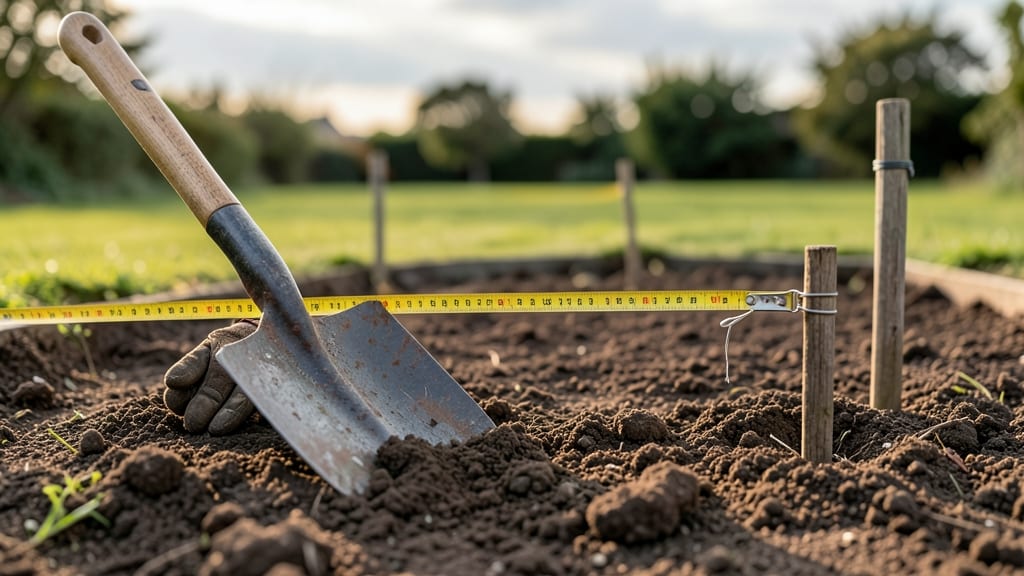
A yard of topsoil covers approximately 270 to 324 square feet, depending on depth: 3 inches spreads about 270 sq ft, while 4 inches covers roughly 200 sq ft. Always check supplier specs for exact measurements before purchasing.
A yard of topsoil is measured in cubic feet, and its spread varies based on how thick you apply it. For a 3-inch layer, you'll cover about 270 square feet, making it ideal for raised beds or small garden patches.
If you need a 4-inch layer, the same yard will only stretch to roughly 200 square feet—perfect for lawn topdressing or preparing new planting areas. 🌱 The key is planning ahead: uneven ground or compaction can reduce coverage further, so I always order 10% extra to account for surprises.
This calculation matters because topsoil depth directly impacts plant health. Shallow layers (2 inches) may not support roots well, while deeper layers (4+ inches) are better for shrubs or trees.
Pro tip: Use a leveling rake to create an even surface before spreading—it maximizes your topsoil's reach and ensures consistent growth across your project.
💡 In This Article
- Calculating Topsoil Coverage for Different Project Depths
- Topsoil Coverage Tips for Landscaping Projects
Calculating topsoil coverage for different project depths
The spread of a yard of topsoil depends entirely on how thick you lay it down. Here's the science: one cubic yard equals 27 cubic feet. When you spread it at 3 inches (about 0.25 feet), you're dividing that volume over a larger area.
The formula is simple: 27 cubic feet ÷ depth in feet = square footage.
For 3 inches, that's 27 ÷ 0.25 = 108 square feet per inch, so 3 inches × 108 = 324 sq ft—though real-world conditions often yield closer to 270 sq ft due to settling.
At 4 inches (or 0.33 feet), the same yard covers less ground because you're spreading the same volume over a thicker layer.
The math becomes 27 ÷ 0.33 ≈ 81.8 sq ft per inch, so 4 inches × 81.8 ≈ 327 sq ft—but again, practical application gives you about 200 sq ft.
The difference comes from how topsoil compacts when spread and watered. 🌱 For example, a 2-inch layer (common for seed beds) would cover roughly 432 sq ft in theory, but in practice, you might only get 360 sq ft after accounting for natural compression.
Why does depth matter so much? Soil depth affects plant root development and moisture retention. A 3-inch layer is ideal for annual flowers or vegetables, while 4+ inches supports perennials or small shrubs. The trade-off is cost: deeper layers mean buying more topsoil.
For instance, covering 1,000 sq ft at 3 inches requires about 3.7 cubic yards, but at 4 inches, you'd need 5 cubic yards. Always verify with your supplier—they may sell "loose" topsoil that settles more than "screened" varieties.
Another critical factor is the topsoil's moisture content. Wet topsoil weighs significantly more (up to 2,000 lbs per cubic yard) and compacts further when spread, reducing coverage by 10-15%.
Dry topsoil, while lighter (1,500 lbs per cubic yard), may spread more evenly but can repel water initially.
Pro tip: If your project requires precise depth, use a laser level or stakes with string to guide your rake—this minimizes waste and ensures consistent coverage across slopes or uneven terrain.
For large projects, like lawn topdressing, consider using a spreader (manual or drop) to achieve uniform depth. These tools distribute topsoil at a set rate, often 0.125 to 0.5 inches per pass, making it easier to hit exact measurements.
For example, a 100 sq ft area at 3 inches would require 2.5 passes with a spreader set to 0.375 inches per pass. Always test a small section first to adjust for your specific topsoil's spread characteristics.
One common mistake is assuming all topsoil spreads the same. Compost-amended topsoil may settle 20-30% more than pure mineral soil due to organic matter breakdown. If your project includes heavy clay or sandy soil, factor in a 10-20% buffer for mixing or blending.
For example, a 500 sq ft garden at 4 inches might need 2.7 cubic yards instead of the calculated 2.1 cubic yards to account for these variables.