
How To
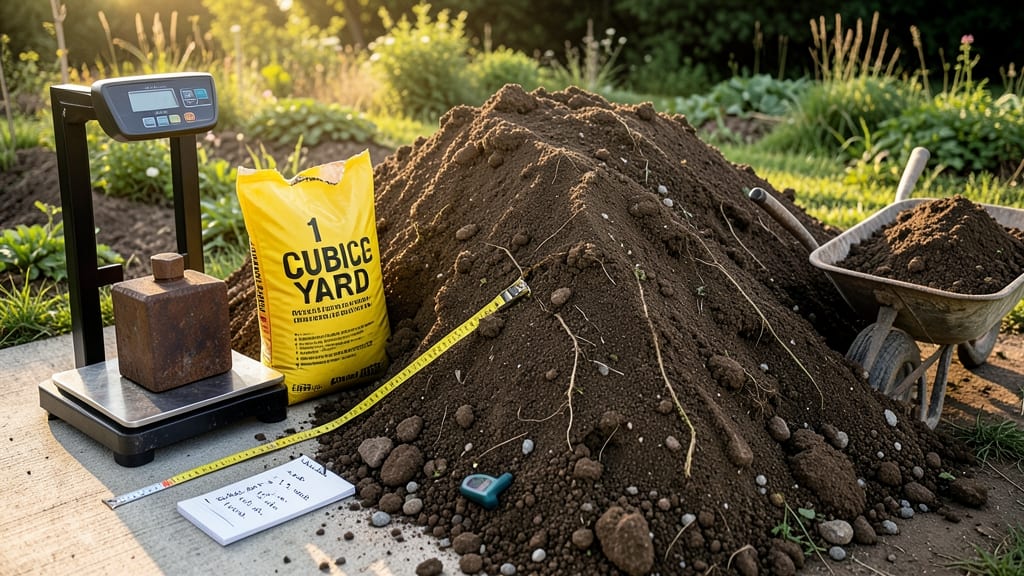
To determine how many cubic yards of soil are in a ton, you'll find the volume ranges from 0.75 to 1.5 cubic yards, with lighter sandy soil hitting the higher end and denser clay or loamy soil closer to 0.75 cubic yards. Always check bulk density for precise project planning.
Understanding this variation matters because soil isn't uniform—moisture content, organic matter, and particle size all play critical roles.
For example, dry, sandy soil might expand to 1.5 cubic yards per ton, while wet clay could shrink to just 0.75 cubic yards. 🌱 I recommend testing your local soil's density using a simple moisture meter or consulting supplier specs, as these factors can shift your project's material needs by 50% or more.
When planning landscaping projects, this means you shouldn't guess—always calculate based on your specific soil type. A common mistake is assuming all soil weighs the same, leading to either shortages or costly overbuying.
For accurate estimates, multiply your project's square footage by desired depth (in feet) and divide by 27 (cubic feet in a yard), then adjust using your soil's bulk density ratio.
💡 In This Article
- Soil Density Variations: Why Weight-to-Volume Ratios Differ
- Practical Soil Volume Calculations for Gardening Projects
Soil density variations: why weight-to-volume ratios differ
Soil density varies dramatically because of its fundamental composition—think of it like comparing packing sand versus clay bricks. Sandy soil has larger particles with more air pockets between them, which makes it lighter and occupy more volume per pound.
For example, dry beach sand might weigh just 80-100 pounds per cubic foot, while dense clay packs tightly with minimal air space, weighing 110-130 pounds per cubic foot.
This particle size difference explains why sandy soil expands to 1.5 cubic yards per ton while clay contracts to 0.75 cubic yards.
The moisture content adds another critical layer—water weighs 8.34 pounds per gallon and fills those air pockets, dramatically increasing density. Wet clay soil can suddenly weigh 20-30% more than its dry counterpart, shrinking its cubic yard equivalent.
Even organic matter plays a role: compost-amended soil contains lighter, decomposing materials that increase volume while reducing weight. Imagine a bag of dry leaves versus packed-down mulch—they occupy vastly different spaces despite similar weights.
Compaction is the final piece of the puzzle. Foot traffic or heavy machinery can compress soil by 15-25%, reducing its volume.
For instance, a freshly tilled garden bed might measure 1.2 cubic yards per ton, but after a week of rain and foot traffic, that same ton could occupy just 0.9 cubic yards. This is why professional landscapers always test soil density on-site rather than relying on supplier averages.
Here's how these factors interact in real scenarios:
- Sandy soil: Low density (75-95 lbs/cubic foot) → 1.3-1.5 cubic yards/ton (high volume)
- Loamy soil: Moderate density (95-110 lbs/cubic foot) → 1.0-1.2 cubic yards/ton
- Clay soil: High density (110-130 lbs/cubic foot) → 0.75-0.9 cubic yards/ton (low volume)
To visualize this, picture a wheelbarrow: one filled with dry sand would overflow compared to one packed with wet clay. The same weight occupies completely different spaces because of these compositional differences. 🌍
For precise calculations, always check your soil's bulk density using a simple field test—dig a known volume hole (like a 1-foot cube), weigh the extracted soil, then divide weight by volume. This gives you your exact cubic yards per ton ratio, accounting for all local variations.