
How To
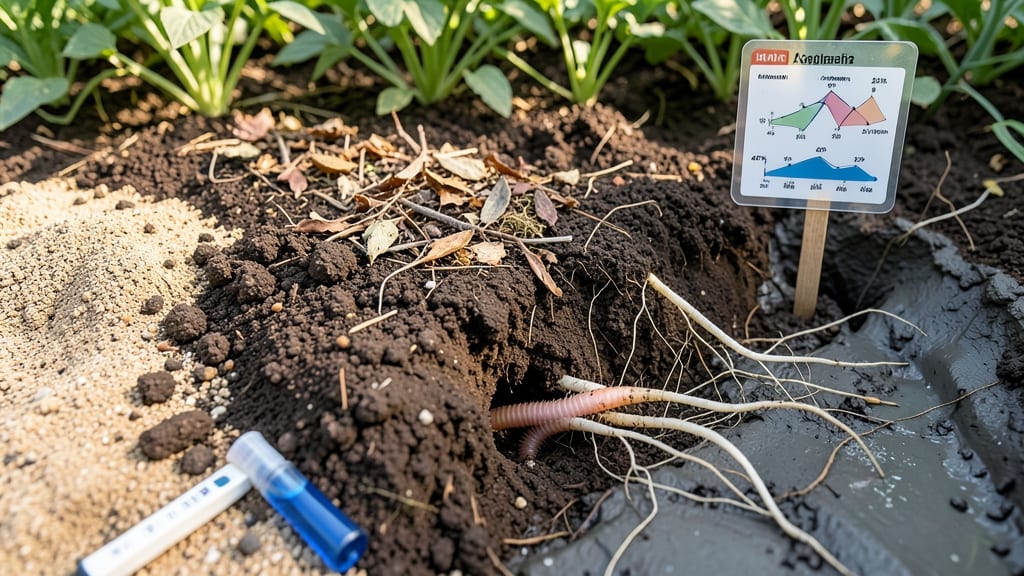
Loamy soil is made of roughly 40% sand, 40% silt, and 20% clay, creating an ideal balance for drainage, aeration, and nutrient retention that supports healthy plant growth and root development.
This perfect blend works because each component plays a unique role: sand provides drainage, silt holds moisture and nutrients, while clay binds everything together. 🌱 The result is a soil that's crumbly yet rich, allowing roots to breathe while retaining essential water and minerals.
Unlike sandy soil that drains too quickly or clay soil that becomes waterlogged, loamy soil gives plants exactly what they need to thrive.
Many gardeners don't realize their soil might be too heavy or too light until they start seeing plants struggle. Testing your soil's composition is the first step toward improvement—simple DIY tests or professional analysis can reveal if you need to add organic matter, sand, or compost.
I've found that adding aged compost often helps shift heavy clay soils toward a more balanced loamy texture over time.
💡 In This Article
- The Science Behind Loamy Soil’s Perfect Texture
- How to Improve Your Garden Soil for a Loamy Texture
The science behind loamy soil’s perfect texture
The magic of loamy soil lies in its particle size distribution, where each component plays a distinct role. Sand particles (0.05-2mm) create the largest spaces between them, allowing air and water to flow freely—this prevents suffocation of roots and stops the soil from becoming waterlogged.
Meanwhile, silt (0.002-0.05mm) acts like a sponge, holding onto moisture and nutrients while still allowing roots to penetrate easily. Clay particles (less than 0.002mm) are the smallest but pack the most surface area, which is where nutrients actually cling to for plant uptake.
What makes this combination work so well is how these particles physically interact.
When you squeeze a handful of loamy soil, it should crumble easily between your fingers—this "crumb structure" forms because sand particles prevent clay from compacting too tightly, while silt acts as a glue between them. 🌱 This structure creates tiny pores (about 0.1-0.2mm in diameter) that hold water against gravity while still allowing oxygen to reach roots.
Compare this to pure clay soil, where particles pack so tightly that water pools on the surface and roots suffocate, or sandy soil where water drains away too quickly for plants to absorb it.
The nutrient retention in loamy soil comes from its massive surface area—clay particles alone can have 10-100 times more surface area than sand per gram of soil.
This means more space for beneficial microbes to colonize and for nutrients like nitrogen, phosphorus, and potassium to be held in a form plants can easily access. The ideal loamy texture also maintains a stable temperature, protecting plant roots from extreme heat or cold that can stress or kill them.
This is why loamy soils can support everything from delicate flowers to hearty vegetables without requiring constant irrigation or fertilization.
You can test your soil's loamy quality with a simple jar test: fill a clear jar with equal parts soil and water, shake vigorously, then let it settle.
After 24 hours, you should see distinct layers with the sand settling first (bottom 20-30%), silt in the middle (40-50%), and clay staying suspended longest (top 20-30%). If your soil lacks one of these layers, that's your first clue about what needs adjustment.
The beauty of loamy soil is that it's not just about the proportions—it's about how these components work together like a well-oiled machine for plant growth.
Consider how this affects your garden: loamy soil can hold up to 25% more water than sandy soil while still providing 30% better aeration than clay-heavy soil. This means plants experience less stress during dry spells and recover more quickly from heavy rains.
The balanced structure also supports beneficial soil organisms like earthworms and mycorrhizal fungi, which further enhance nutrient availability. 🌿 Without this microbial activity, even the best soil composition would struggle to maintain its fertility over time.
What most gardeners don't realize is that loamy soil isn't static—it's a dynamic ecosystem. The organic matter (like decomposed leaves or compost) in loamy soil acts as a glue that helps maintain this perfect structure while continuously replenishing nutrients.
This is why healthy loamy soil often looks dark brown or black from all the organic material incorporated into it. The more organic matter present, the better the soil's ability to hold onto nutrients and resist compaction from foot traffic or machinery.