
How To
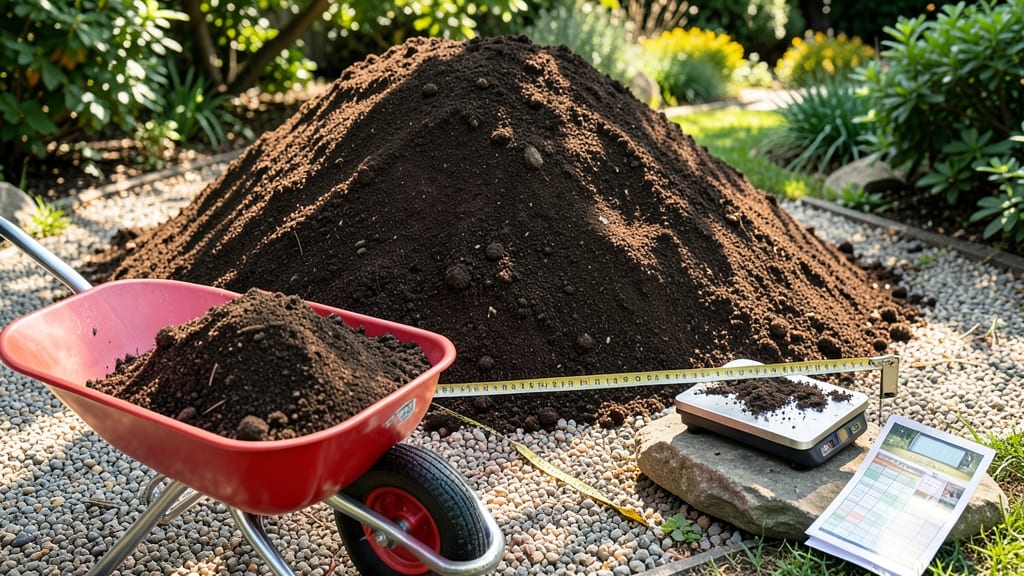
Converting cubic yards of soil to tons requires accounting for soil type and moisture levels: dry topsoil typically weighs 1.5–1.7 tons per cubic yard, while moist or clay-based soil can weigh 2.2–2.5 tons per cubic yard. Always use a moisture-adjusted conversion chart for precise calculations in landscaping or gardening projects.
Soil weight varies dramatically based on its composition and moisture content. 🌱 For instance, sandy soil is lighter due to its loose particles, while clay holds more water and becomes significantly heavier.
Even a small increase in moisture can add 0.5–1 ton per cubic yard to the weight, making accurate measurements critical for projects like garden beds or land grading. I always recommend testing a small sample—dry it out and weigh it to get a baseline before scaling up.
This variation explains why contractors and gardeners use specialized conversion tables rather than generic estimates. For example, a 10 cubic yard delivery of moist clay soil could weigh nearly 25 tons, while the same volume of dry sand might only reach 15 tons.
Always double-check with your supplier or use an online calculator that accounts for your specific soil type and local moisture conditions.
💡 In This Article
- How Soil Density and Moisture Affect Weight Conversions
- Best Soil Weight Conversion Tools for Gardeners and Landscapers
How soil density and moisture affect weight conversions
Soil weight conversions hinge on two key factors: particle density and moisture content. Sandy soil, with its large, loosely packed grains, typically weighs 1.4–1.6 tons per cubic yard when dry because air fills the gaps between particles.
In contrast, clay soil has tightly packed, flat particles that trap water, pushing its dry weight up to 1.8–2.2 tons per cubic yard. The difference becomes even more dramatic when wet—clay can absorb up to 50% of its weight in water, while sand holds only 10–20%. 🧲
Moisture plays a critical role because water adds significant bulk. A cubic yard of dry topsoil might weigh 1.5 tons, but after a rainstorm, that same volume could swell to 2 tons or more. This is why clay-heavy soils often exceed 2.5 tons per cubic yard when saturated.
Even organic-rich soils like composted loam can vary widely—dry, they might weigh 1.2–1.4 tons, but when moist, they can approach 1.8 tons. The porosity of the soil (how much air or water it can hold) directly impacts these conversions.
Compaction further complicates the equation. When soil is tilled or driven over, particles pack more tightly, reducing air pockets and increasing density.
For example, a freshly tilled garden bed might weigh 1.6 tons per cubic yard, but after heavy machinery passes through, that same volume could reach 1.9 tons.
This is why professional landscapers always test soil in situ—digging a small hole, weighing the extracted soil, and adjusting calculations based on real-world conditions rather than textbook averages.
Understanding these variations is crucial for practical applications. A gardener planning a 5 cubic yard raised bed filled with moist loam might need to account for 8–10 tons of material, not the 7.5 tons they’d estimate using dry soil averages.
Similarly, contractors moving soil for erosion control projects must factor in seasonal moisture changes—spring clay can weigh 30% more than summer clay. Always err on the side of caution when estimating loads for delivery or removal.
For precise work, consider the bulk density of your soil—a measurement that combines particle density and porosity. Sandy soils often have bulk densities around 1.4–1.6 g/cm³, while clay soils can reach 1.8–2.2 g/cm³. Multiply this by the volume (converted to cubic centimeters) to get an accurate weight.
For example, a cubic yard of clay soil with a bulk density of 1.9 g/cm³ would weigh approximately 2.1 tons—a critical distinction when planning heavy equipment logistics.
One practical tip: If you’re working with unknown soil, take a 1-gallon sample, dry it completely in an oven at 212°F for 24 hours, and weigh it. Compare this to the original wet weight to calculate your soil’s moisture content.
This simple test can save you from underestimating loads or overpaying for deliveries. For most gardeners, this method yields results within 5% of professional lab tests—close enough for accurate planning.