
Landscaping
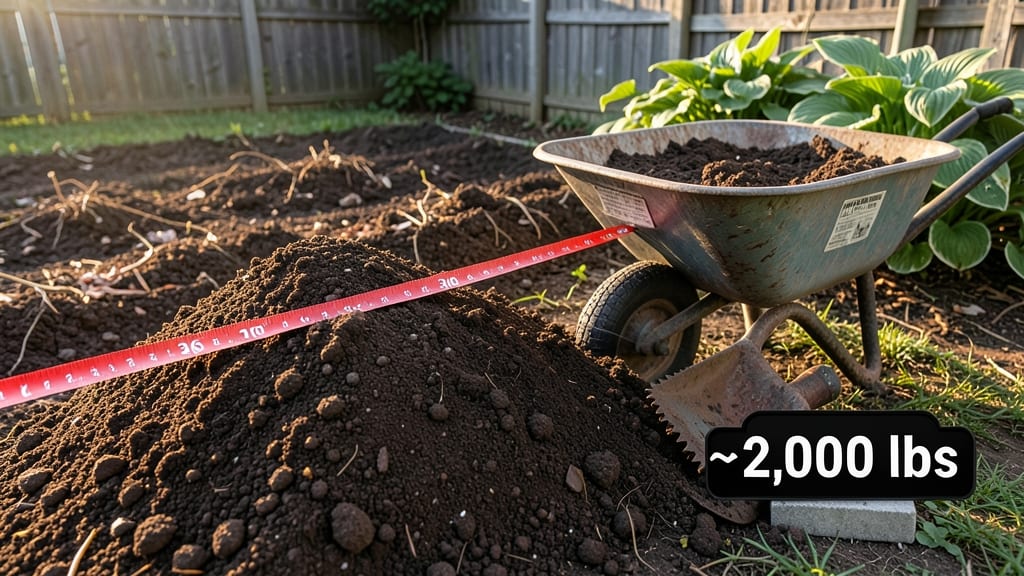
A cubic yard of topsoil typically weighs between 1,800 to 2,200 pounds, with variations based on how moist it is and what type of soil it is—sandy soil is lighter, while clay-heavy soil can be significantly heavier. Most loamy topsoil lands right around 2,000 pounds.
A cubic yard of topsoil isn't just dirt—it's a dynamic mix of minerals, organic matter, and water that changes weight dramatically. 🌱 Sandy soils, with their larger particles, weigh less because they contain more air pockets, while clay soils pack tightly with water, adding pounds.
Even a 10% moisture increase can add 100-200 pounds to your load! This is why landscapers always ask about your project's moisture conditions before delivering.
Understanding this helps with everything from truck capacity to project planning. For example, a 10x10-foot garden bed with 6 inches of topsoil needs about 7 cubic yards—if you're using clay soil, that's nearly 15,400 pounds of material to move!
Always check with your supplier about current moisture levels to avoid surprises during delivery.
💡 In This Article
- How Soil Composition Affects Topsoil Weight
- Calculating Topsoil Weight for Landscaping Projects
How soil composition affects topsoil weight
The weight of topsoil varies dramatically based on its particle size distribution, which determines how tightly the soil packs together. Sandy soil, with particles ranging from 0.05 to 2 millimeters, has large air gaps between grains, making it lighter—typically weighing around 1,600-1,800 pounds per cubic yard when dry.
In contrast, clay soil has particles smaller than 0.002 millimeters that pack tightly, trapping water and increasing weight to 2,000-2,400 pounds per cubic yard or more when saturated. 🌍
Silt, with medium-sized particles (0.002-0.05 millimeters), falls between these extremes, usually weighing 1,800-2,100 pounds per cubic yard. Loamy soil—the ideal mix of 40% sand, 40% silt, and 20% clay—balances these properties, typically weighing 2,000 pounds when moist.
The key factor is porosity: sandy soils have higher porosity (more air), while clay soils have lower porosity but higher water retention, significantly boosting weight.
Moisture content is the wild card here. Dry topsoil can weigh 20-30% less than its saturated counterpart. For example, clay soil might drop from 2,400 pounds when wet to 1,800 pounds when bone-dry.
Organic matter also plays a role—compost-rich soil can weigh slightly less due to its lighter organic components, but it retains more moisture, complicating weight calculations. 💧
Compaction further alters weight. When soil is tilled or driven over (like in construction sites), its density increases by 10-20%**, adding hundreds of pounds per cubic yard.
This is why landscapers often recommend testing soil moisture before delivery—wet clay soil can exceed 2,500 pounds per cubic yard, straining delivery trucks and equipment. Always specify "dry" or "moist" when ordering to avoid surprises.
Here's a quick comparison of dry vs. saturated weights:
- Sand: 1,600 lbs (dry) vs. 1,800 lbs (moist)
- Silt: 1,800 lbs (dry) vs. 2,100 lbs (moist)
- Clay: 1,800 lbs (dry) vs. 2,400 lbs (saturated)
- Loam: 1,900 lbs (dry) vs. 2,000 lbs (moist)
Understanding these variations helps you plan for delivery logistics, equipment needs, and even soil amendments. For instance, if your project requires 10 cubic yards of clay soil at 2,200 pounds per yard, you're looking at 22,000 pounds—that's roughly the weight of 11 sedans!
Always factor in moisture conditions to keep your project on track. ✨