
Neem Oil
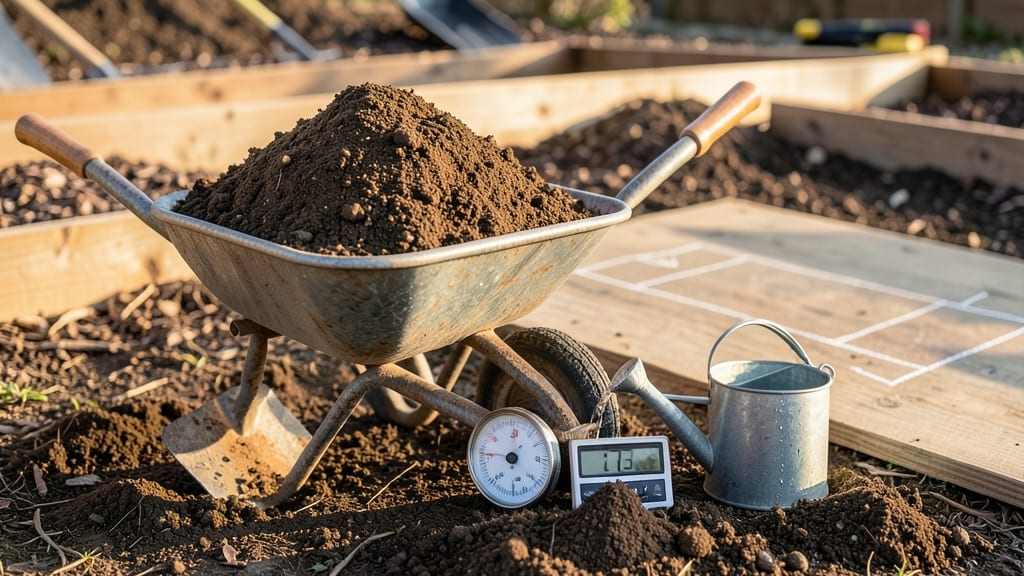
Understanding how much a cubic yard of soil weighs reveals a range from 1,350 to 3,000 pounds, where moisture levels and composition play critical roles—dry, sandy soil leans toward the lighter end, while saturated clay-heavy soil can reach the heavier spectrum. Organic additions can push the weight up by nearly a fifth.
This weight variation stems from soil's unique makeup: moisture content alone can add hundreds of pounds to a cubic yard, while organic matter like decomposed leaves or compost increases density by altering particle structure.
For example, topsoil—rich in organics—typically weighs closer to 2,000 pounds, whereas sterile construction fill might barely hit 1,500. 🌱 These differences matter when planning projects like raised garden beds or erosion control, where weight impacts structural support and delivery costs.
To estimate accurately, consider three key factors: moisture (test by squeezing a handful—if it holds shape, it's wet), particle size (clay feels smooth; sand is gritty), and organic content (dark, crumbly soil has more).
For precision, use a moisture meter or compare samples to known densities—this avoids overestimating (and overpaying) for bulk deliveries. I always check with suppliers for their specific soil weights before ordering, especially for large landscaping jobs where weight affects truck capacity.
💡 In This Article
- Soil Density Factors Affecting Cubic Yard Weight
- Practical Weight Calculations for Gardening Projects
Soil density factors affecting cubic yard weight
Soil weight per cubic yard is fundamentally determined by its bulk density, which measures how tightly particles are packed.
Dry, sandy soil has a bulk density of about 90-105 pounds per cubic foot (translating to ~1,500-1,800 pounds per cubic yard), while clay soils—with their microscopic plate-like particles—can reach 110-130 pounds per cubic foot (~2,200-2,600 pounds per cubic yard).
The difference lies in porosity: sand has large air pockets (35-45% void space), while clay's particles pack tightly (40-60% solids by volume). 🌱
Moisture content is the wild card—water adds 62.4 pounds per cubic foot (1,000 pounds per cubic yard when fully saturated). A cubic yard of dry sand (1,500 lbs) becomes 2,500+ pounds when waterlogged, while clay's weight increases more modestly due to its existing density.
Organic matter compounds this: composted leaves or peat moss can increase weight by 15-20% by filling pore spaces and adding biomass. For example, a cubic yard of garden soil with 10% organic content might weigh 2,200 pounds versus 1,800 for pure mineral soil.
Real-world examples highlight these variations: Construction fill (crushed stone/sand) often weighs 1,500-1,700 pounds due to controlled grading, while topsoil averages 1,800-2,200 pounds from organic enrichment.
I once calculated that a 10'x12' raised bed (1.33 cubic yards) filled with clay-loam topsoil would weigh 2,700 pounds—enough to require structural reinforcement for the frame. This weight distribution explains why clay soils feel heavier when wet (they hold water between particles) while sand drains quickly but remains dense.
The science behind this involves specific gravity—the ratio of soil particle density to water. Quartz sand has a specific gravity of 2.65, while organic matter averages 1.3-1.5. When mixed, these values create a composite density where even small organic additions significantly alter the cubic yard weight.
For instance, replacing 20% of sand with compost increases the bulk density from 1.4 to 1.6 g/cm³, adding 150 pounds per cubic yard. 💡
Particle shape also matters: angular sand grains interlock tightly, while rounded particles (like river gravel) create more void space. Clay's flat particles align like stacked plates, reducing overall volume. This geometric packing explains why a cubic yard of clay can weigh nearly double that of sand—despite both being "soil."
For gardeners, this means amending heavy clay with sand isn't just about drainage; it's a weight-reduction strategy for easier handling and reduced structural load on garden beds.
One often-overlooked factor is compaction. Loose, freshly tilled soil weighs 10-15% less per cubic yard than when compacted (e.g., by foot traffic or machinery).
This is why bulk deliveries specify "loose" versus "compacted" weights—what seems like a 2,000-pound cubic yard in a truck may shrink to 1,800 pounds after spreading. Understanding this helps avoid overordering for projects like slope stabilization, where compacted soil provides better erosion control but requires heavier equipment to move.