
Landscaping
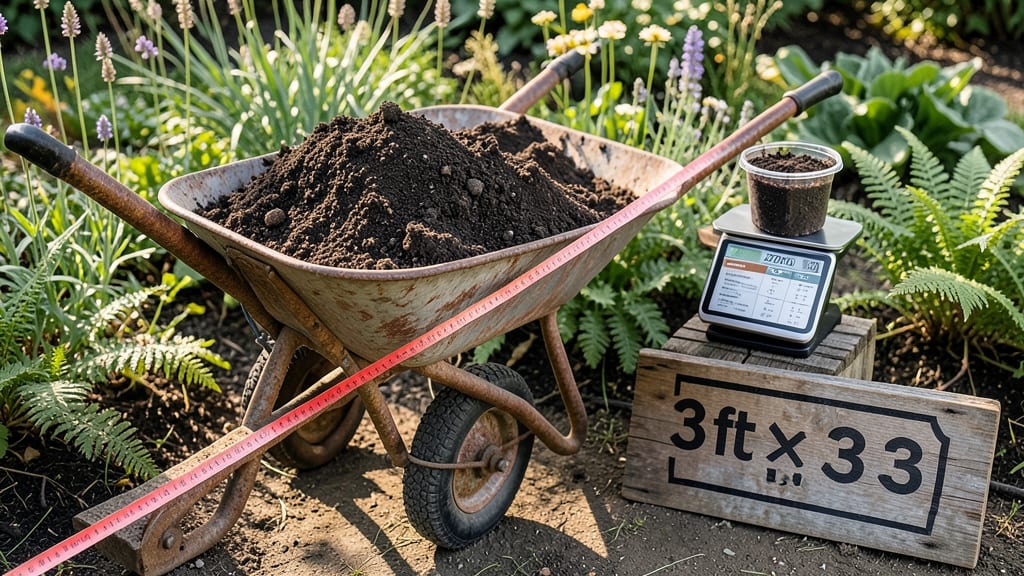
The weight of soil per cubic yard varies significantly by type: dry sand typically ranges from 2,600–2,800 pounds, while loamy soil falls between 2,000–2,400 pounds, clay weighs 2,200–2,900 pounds, and peat moss is the lightest at 1,000–1,500 pounds, with moisture and compaction adding up to 30% extra weight.
Understanding these variations is key for landscaping projects, as soil density directly impacts transportation costs and structural considerations.
For example, clay's heavier weight means it requires stronger materials for pathways or raised beds, while peat moss—though lightweight—can compress significantly when wet, altering its weight over time. 🔥 The moisture content plays a huge role: a single cubic yard of dry loam might weigh 2,200 pounds, but when saturated, that same volume could exceed 2,800 pounds due to absorbed water weight.
Most landscapers adjust their calculations by accounting for a 15–30% buffer when ordering soil, especially for projects like garden beds or slopes where compaction is inevitable.
Peat moss, despite its low base weight, often needs this adjustment because it absorbs water like a sponge, making it heavier in real-world conditions than the dry measurements suggest.
💡 In This Article
- How Soil Composition Affects Weight per Cubic Yard
- Practical Soil Weight Calculations for Landscaping Projects
How soil composition affects weight per cubic yard
Soil weight per cubic yard is fundamentally determined by its particle size distribution and organic content. Sand, composed of large, coarse particles, has minimal pore space when dry, giving it a higher density—around 2,600–2,800 pounds—because the particles pack tightly together.
In contrast, clay particles are tiny and plate-like, creating a dense matrix when dry, but their ability to hold water between particles makes them heavier when moist (up to 2,900 pounds).
Loamy soil, the ideal mix of sand, silt, and clay (about 40% sand, 40% silt, 20% clay), strikes a balance, weighing 2,000–2,400 pounds due to its balanced porosity and organic matter. 🔥
The organic matter content dramatically alters weight too. Peat moss, which is 90% organic, weighs only 1,000–1,500 pounds per cubic yard when dry because its fibrous structure traps air. However, when saturated, it can absorb 3–5 times its dry weight in water, making it deceptively heavy in real-world applications.
Compost-amended soils also see weight fluctuations—adding 10% compost to clay can reduce its density by 10–15% due to increased porosity. The key factor here is bulk density, a measure of how tightly particles pack, which varies wildly between soil types.
Moisture is the wildcard in soil weight calculations. Water fills the voids (pores) between particles, and since water weighs 62.4 pounds per cubic foot, even a 10% moisture increase can add 150–300 pounds to a cubic yard of soil.
For example, dry loam at 2,200 pounds becomes 2,500–2,800 pounds when fully saturated. This is why landscapers often use field capacity (the moisture level soil holds against gravity) as a baseline—it accounts for real-world conditions where soil isn’t bone-dry. 💛
Compaction further complicates weight estimates by reducing pore space. A 10% compaction (common in foot traffic or machinery use) can increase soil weight by 5–15% because fewer air pockets remain.
Clay soils are particularly prone to this—when tilled wet, they can become 20% denser, pushing their weight toward the upper limit of their range. Conversely, loose, aerated soils like sandy loam might see minimal weight gain from compaction because their larger particles resist compression.
Understanding these dynamics helps avoid underestimating material needs for projects like pathways or garden beds.
Here’s a quick breakdown of how particle size and moisture interact to influence weight:
- Sand: Large particles, low porosity → High dry weight, minimal moisture impact (adds <10% when wet)
- Clay: Tiny particles, high surface area → Low dry weight but absorbs 30–50% water by volume (adds 15–25% to weight)
- Silt: Medium particles, moderate porosity → Balanced weight, moderate moisture retention (adds 10–15%)
- Organic (peat/compost): High porosity, water-absorbent → Low dry weight but can double in weight when saturated
For practical purposes, always assume wet conditions unless working in arid climates. A cubic yard of "dry" soil in a nursery might actually contain 10–20% moisture, skewing your weight calculations if you rely solely on dry measurements. ✨