
How To
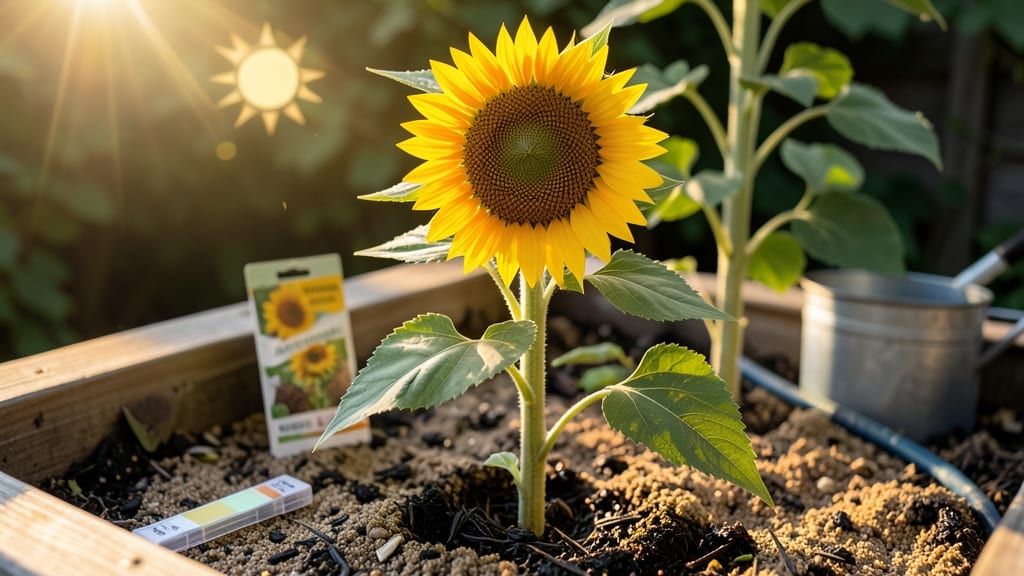
Sunflower soil requirements call for a fertile, well-draining loam blend with 60% loam, 20% sand, and 20% compost, a slightly alkaline pH of 6.0–7.5, and rich organic matter to fuel rapid root growth and strong stems for vigorous flowering.
Sunflowers need soil that balances drainage and nutrient retention, which is why the right texture matters so much. 🌻 The 60-20-20 loam mix prevents waterlogging while holding moisture for deep roots, while the alkaline pH unlocks key nutrients like phosphorus and calcium.
I've found that adding aged compost not only improves structure but also introduces beneficial microbes that help break down nutrients faster—critical for those towering stalks!
For heavy clay soils, mix in extra sand and perlite to improve aeration, while sandy soils benefit from generous compost additions. The pH range might seem narrow, but sunflowers struggle below 6.0 because acidic conditions lock out essential minerals.
A simple lime application can adjust pH if needed, but testing first saves time and money.
💡 In This Article
- Why Sunflowers Thrive in Loamy Soil with Specific pH
- DIY Sunflower Soil Mix: Step-by-Step Loam Blending Guide
Why sunflowers thrive in loamy soil with specific pH
Sunflowers develop deep taproots that can reach 6-12 feet underground, which means their soil must balance aeration with moisture retention. Loamy soil—composed of roughly 40% mineral particles (sand/silt/clay) and 60% organic matter—provides this perfect equilibrium.
The sand component (20% of the mix) creates air pockets that prevent root suffocation, while the silt and clay particles hold water and nutrients near the roots. Without this balance, roots either drown in compacted clay or dry out in pure sand, both of which stunt growth. 🌱
The slightly alkaline pH range of 6.0–7.5 is critical because sunflowers need accessible phosphorus and calcium for strong stems and vibrant blooms. At lower pH levels, these nutrients bind to soil particles and become unavailable.
For example, phosphorus solubility drops dramatically below pH 6.0, causing stunted growth even if the soil appears fertile. The organic matter in the mix (like compost) also buffers pH fluctuations, creating a stable environment where beneficial microbes thrive to break down nutrients into forms the plant can absorb.
Organic matter plays a dual role: it improves soil structure by binding particles together while also providing a slow-release nutrient source. Fresh compost introduces beneficial microbes that decompose organic material, releasing nitrogen, potassium, and micronutrients over time.
This microbial activity is especially important during the rapid growth phase when sunflowers need 2-3 pounds of nitrogen per 100 square feet. Without this microbial boost, synthetic fertilizers alone can't match the nutrient availability, leading to weaker stems and smaller heads.
Visualize the ideal sunflower soil as a sponge: it holds water near the surface for young seedlings while allowing excess to drain away, preventing root rot. The loam's crumbly texture also makes it easier for roots to penetrate, reducing resistance that could slow growth.
In contrast, heavy clay soils (common in many gardens) can become waterlogged, while sandy soils dry out too quickly—both scenarios stress sunflowers and reduce their iconic height potential. 🌻
One often-overlooked factor is the soil's cation exchange capacity (CEC), which measures its ability to hold nutrients. Loamy soils with 10-30 meq/100g CEC provide the perfect balance: they retain enough nutrients to support sunflowers' rapid growth but don't become nutrient-starved between waterings.
This CEC is directly tied to the organic matter content, which is why amending with compost isn't just about adding nutrients—it's about creating a soil environment where those nutrients become available when the plant needs them most.