
Light Requirements
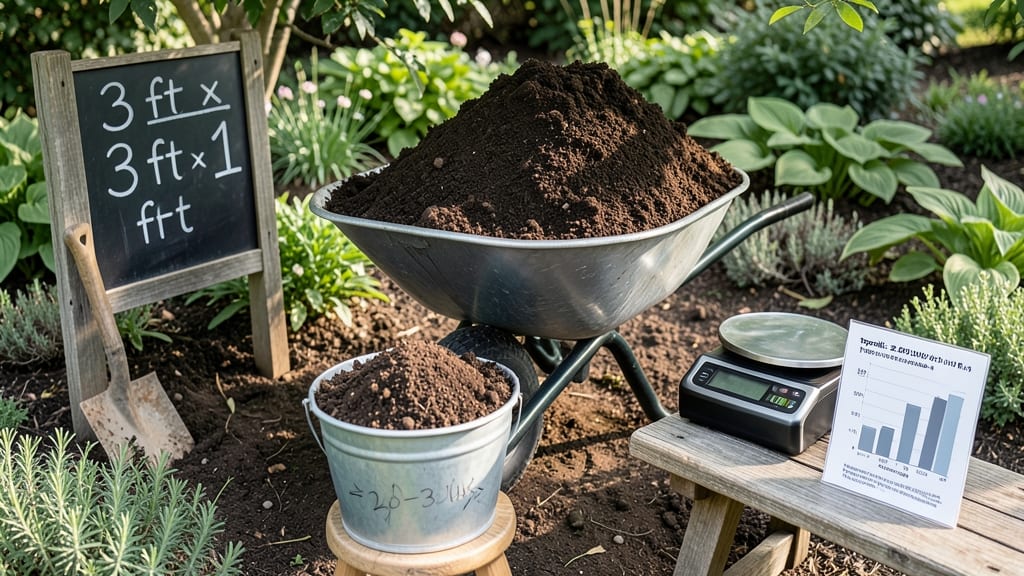
To determine how much one yard of soil weighs, expect a range of 1,800 to 3,000 pounds, with sandy soil weighing closer to 2,000 lbs and moist clay or loamy soil reaching over 2,800 lbs. Always confirm with suppliers for exact measurements before transporting.
Understanding soil weight isn't just about the numbers—it's about the science behind what you're moving. 🌱 The moisture level plays the biggest role: dry soil can weigh 20-30% less than saturated soil.
For example, a wheelbarrow full of damp garden soil might feel twice as heavy as the same volume when bone-dry.
I always recommend testing a small sample first by weighing it in a bucket before calculating larger quantities, especially for projects like raised beds where precise measurements matter for structural support.
What's fascinating is how particle size affects this too. Sand particles pack loosely, leaving air pockets that reduce overall weight, while clay particles cling together tightly when wet, creating a denser mass.
This is why a cubic yard of sandy loam might weigh 2,200 lbs, but the same volume of pure clay could tip the scales at 2,900 lbs when fully hydrated.
For practical purposes, I keep a moisture meter handy when ordering bulk soil—it saves headaches during transport and helps avoid overloading equipment.
💡 In This Article
- Factors That Change Soil Weight per Cubic Yard
- Practical Weight Calculations for Gardening Projects
Factors that change soil weight per cubic yard
Soil weight isn't static—it fluctuates based on moisture content, which can vary by up to 30% between dry and saturated conditions.
For instance, dry sandy soil might weigh around 1,800 lbs per cubic yard, but when fully saturated, the same volume can swell to 2,400 lbs due to water absorption in the pore spaces. This happens because water fills the gaps between particles, increasing overall mass without changing volume.
Clay soils are especially dramatic in this regard, as their tiny particles create microscopic spaces that hold water like a sponge.
The particle composition plays a critical role too. Sandy soils have large particles with minimal surface area, resulting in lower bulk density (~80-100 lbs per cubic foot). In contrast, clay soils pack tightly due to their flat, plate-like particles, giving them a higher bulk density (~100-130 lbs per cubic foot).
Loamy soils—ideal for gardening—fall in between, typically weighing 2,200-2,600 lbs per cubic yard when moist. The key difference lies in how these particles arrange themselves: sand creates loose, airy structures, while clay forms dense, compacted layers.
Organic matter also influences weight significantly. Compost-amended soils can weigh 10-20% less than pure mineral soils because organic materials are less dense and contain more air pockets.
For example, a mix of 50% topsoil and 50% compost might weigh closer to 1,900 lbs per cubic yard compared to 2,500 lbs for straight topsoil. This is why gardeners often blend soils—they're trading some weight for improved drainage and nutrient content, which directly impacts plant growth. 🌱
Compaction is another hidden factor. When soil is heavily compacted—common in construction sites or after heavy machinery use—its weight per cubic yard can increase by 15-25% due to reduced pore space. For instance, a cubic yard of compacted clay might weigh 3,000 lbs versus 2,400 lbs in its natural state.
This is why landscape professionals often recommend aerating soil before planting to restore its natural porosity and reduce weight-related stress on plant roots.
Temperature even plays a subtle role. In colder climates, frozen soil can temporarily increase in weight by 5-10% as ice forms in the pore spaces. Conversely, in arid regions, extremely dry soils may lose 10-15% of their weight due to moisture loss.
These variations explain why suppliers often provide weight ranges rather than fixed numbers—soil is a dynamic material that responds to environmental conditions. For precise calculations, always check moisture levels with a soil moisture meter or by weighing a known volume in a bucket.
Understanding these factors helps explain why a truckload of soil might feel unexpectedly heavy or light. For example, a 10-cubic-yard load of sandy loam could weigh anywhere from 20,000 to 26,000 lbs, depending on moisture.
This variability is why construction crews and gardeners alike carry moisture meters and adjust their equipment accordingly—especially when dealing with heavy clay or lightweight compost blends. 💡