
Light Requirements
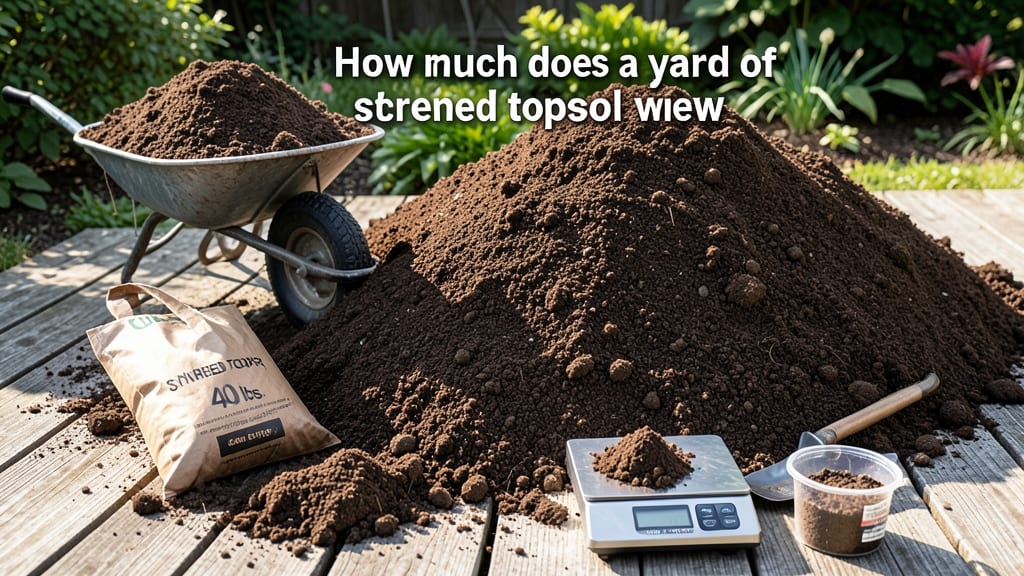
To determine how much a yard of screened topsoil weighs, expect 2,000 to 2,700 pounds—this range accounts for variations in moisture levels and how tightly the soil is packed. Dry, loose soil sits at the lighter end, while damp or compressed soil can push toward the heavier side.
A yard of screened topsoil's weight isn't fixed because it depends on two key variables: moisture content and compaction. Wet soil can weigh up to 30% more than dry soil due to absorbed water, while tightly packed soil in delivery trucks or storage piles increases density.
For example, freshly tilled garden soil often falls in the 2,200-2,500 pound range, whereas soil delivered in bulk bags may tip toward the heavier end. Always ask your supplier about their specific moisture levels when ordering—this simple check can save you from underestimating your project's material needs. 🔥
Understanding this variation helps with planning. If you're filling a raised garden bed or leveling uneven terrain, knowing the weight ensures you account for proper support and transportation logistics.
Most landscaping projects assume a middle-ground weight of 2,400 pounds per cubic yard for basic calculations, but verifying with your supplier gives you the most accurate estimate for your specific soil type.
💡 In This Article
- Factors Affecting Screened Topsoil Weight
- Calculating Topsoil Needs for Landscaping Projects
Factors affecting screened topsoil weight
Moisture content is the single biggest variable in screened topsoil weight. A cubic yard of bone-dry soil might weigh around 2,000 pounds, but add just 15-20% moisture (which is common in freshly screened soil) and that same volume jumps to 2,400-2,500 pounds.
The science here involves capillary action—water molecules cling to soil particles, filling the microscopic air pockets between them. This creates what engineers call "apparent density," where the same volume suddenly feels heavier due to water displacement.
Particle size distribution also plays a critical role. Screened topsoil typically contains 10-30% sand, 30-50% silt, and 20-40% clay, with larger particles creating more air gaps when dry.
Clay-heavy soils can weigh up to 30% more per cubic yard than sandy soils because clay particles pack more tightly. Compaction matters too—vibrating trucks or heavy machinery can increase density by 10-15%, turning a loose 2,200-pound load into a compacted 2,500-pound pile.
The texture difference is dramatic: dry, loose soil feels like crumbly cake mix, while compacted soil resembles damp concrete.
Organic matter content adds another layer of complexity. Soil with 5-10% organic material (like decomposed leaves or compost) weighs slightly less per cubic yard because organic matter has lower bulk density than mineral particles. However, this organic material improves water retention, which can paradoxically increase overall weight when wet.
Regional differences further complicate calculations—northern soils often contain more organic matter and humus, while southern soils may have higher clay content from weathering. For example, Midwest topsoil might average 2,300 pounds per yard, while Pacific Northwest soil could approach 2,600 pounds due to higher organic content.
Temperature affects weight too, though less dramatically. Cooler soils hold moisture differently than warm soils, with winter deliveries potentially weighing 5-10% more than summer deliveries due to reduced evaporation.
The weight difference becomes noticeable when ordering large quantities—what seems like a 2,400-pound load in summer might become a 2,600-pound challenge in winter. This seasonal variation explains why many suppliers offer moisture-adjusted weight guarantees during their contracts.
One often-overlooked factor is the screening process itself. Soil that's been through a 3/8-inch or 1/2-inch screen will have fewer large particles, creating more air space and reducing overall weight compared to unscreened soil. The screening removes rocks and debris that would otherwise increase density.
For instance, screened soil might weigh 2,200 pounds per yard, while the same volume of unscreened soil could reach 2,500 pounds due to the added weight of stones and organic debris.
This is why landscapers always specify "screened" when ordering—it's not just about cleanliness, but also about predictable weight calculations.
To visualize these variations, imagine carrying a 5-gallon bucket of each type: dry screened soil feels light like flour, while wet compacted soil resembles a sandbag.
The weight difference becomes critical when planning for delivery trucks—most have 10-12 ton capacity limits, meaning you can fit about 4-5 cubic yards of dry soil or only 3-4 yards of wet, compacted soil per trip. Understanding these factors helps you avoid costly over-ordering or frustrating delivery delays.