
Light Requirements
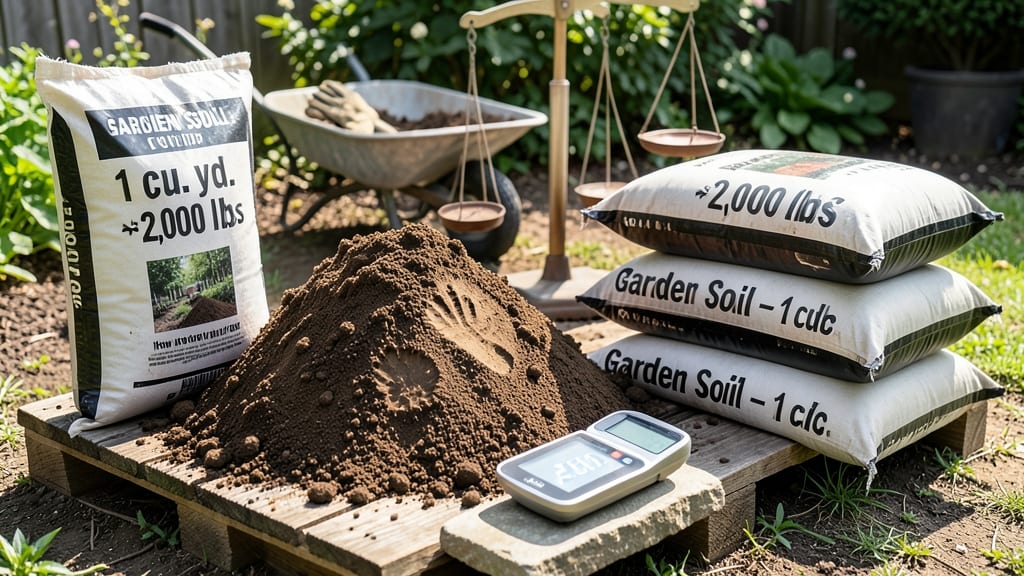
A yard of garden soil typically weighs between 1,800 to 2,200 pounds, with variations based on moisture levels and soil composition. Sandy soils usually fall closer to 1,800 lbs, while heavier clay or wet soils can push over 2,200 lbs.
A yard of garden soil's weight isn't just about volume—it's heavily influenced by how much water it holds and what minerals it contains. 🌱 For example, a freshly tilled loam soil might weigh around 2,000 lbs, but after a heavy rain, that same yard could swell to 2,500 lbs due to water absorption.
This is why professional landscapers always check soil moisture before estimating delivery needs. Understanding these variations helps you plan for proper equipment and transportation, especially when dealing with large garden projects or commercial landscaping.
If you're planning a major garden project, consider requesting a soil test from your supplier. This can reveal the exact composition and help you adjust your calculations. For instance, organic-rich soils often weigh more than standard garden soil due to decomposed plant matter, while pure sand stays consistently light.
Always confirm with your supplier—they'll have the most accurate data based on their local soil sources and delivery methods.
💡 In This Article
- Factors That Change Garden Soil Weight per Cubic Yard
- Practical Tips for Estimating and Handling Soil Weight
Factors that change garden soil weight per cubic yard
The weight of garden soil isn't fixed—it shifts dramatically based on its bulk density, a measure of how tightly particles are packed.
Sandy soils have loose particles with large air pockets, giving them a lower density (~1,800 lbs per cubic yard), while clay soils pack tightly with minimal air space, often exceeding 2,200 lbs. The key difference lies in particle size: sand grains (0.05-2mm) create porous structures, whereas clay particles (<0.002mm) cling together like a dense sponge. 🌍
Moisture content plays an even bigger role than particle type. Dry soil might weigh 1,800 lbs, but after absorbing water, that same yard could swell to 2,500 lbs—water alone adds 1,000 lbs or more to the total weight.
This is why professionals use a simple field test: squeeze a handful of soil—if it holds its shape, it's wet and heavier; if it crumbles, it's dry. Organic matter also increases weight; compost-amended soils can weigh 20-30% more than mineral-only mixes due to decomposed plant material's density.
Compaction from machinery or foot traffic further alters weight. A freshly delivered yard of soil might weigh 2,000 lbs, but after being tilled or walked on, it could compress to 2,400 lbs as air pockets collapse. This is why landscapers always specify "loose" or "compacted" weight in delivery quotes.
The science behind this involves porosity: sandy soils have 30-40% air space, while clay soils retain only 10-20% air, making them heavier when saturated. 💧
Temperature affects weight too—frozen soil can weigh 10-15% more than thawed soil due to ice crystals forming between particles. This seasonal variation explains why winter deliveries often require heavier equipment. For precise calculations, soil scientists use bulk density formulas (mass/volume), where volume accounts for both solids and voids (air/water).
A typical garden soil's bulk density ranges from 1.2 to 1.6 grams per cubic centimeter, translating to our familiar 1,800-2,200 lb range per yard.
Consider this real-world example: A 10-yard delivery of sandy loam soil might weigh 18,000 lbs (1,800 lbs/yd³ × 10), but if it's clay-heavy and wet, the same volume could hit 22,000 lbs. This 20% weight difference impacts everything from truck rental costs to foundation support for raised beds.
Always ask suppliers for their tested bulk density values—they'll often provide this data for local soil blends. 📊
One often-overlooked factor is salinity. Soils high in dissolved minerals (common in coastal areas) can weigh 5-10% more than freshwater-irrigated soils due to mineral deposits.
For instance, a yard of saline clay might tip the scales at 2,400 lbs, while identical non-saline clay stays at 2,200 lbs. This explains why coastal gardeners sometimes pay premium prices for "washed" soil blends with reduced mineral content. 🌊
For DIY gardeners, the simplest way to estimate is the "fist test": pack soil into a 1-cubic-foot container (12" × 12" × 12"). Weigh it—most garden soils average 80-100 lbs per cubic foot, meaning a cubic yard (27 cubic feet) will fall into our 1,800-2,200 lb range.
Keep this reference handy when comparing supplier quotes or planning heavy equipment needs. ✨