
Light Requirements
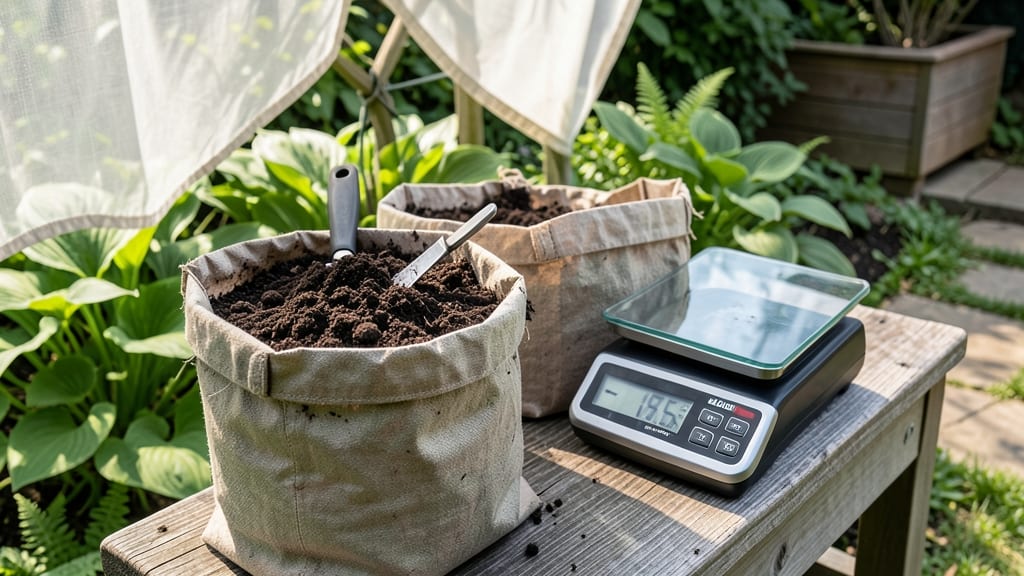
To determine how much a gallon of soil weighs, expect 12 to 18 pounds for dry garden soil, though sandy soil runs lighter (10-14 lbs) while clay-heavy or loamy soil can hit 20 pounds or more. Adding moisture can double or even triple that weight!
Understanding soil weight is all about its composition and moisture levels. The particle size and density play a huge role—sandy soil has larger air pockets, making it lighter, while clay holds more tightly packed particles. 💧 When soil gets wet, water fills those gaps, adding significant bulk.
For example, a gallon of dry potting mix might weigh 15 pounds, but after watering, it could easily jump to 25 pounds!
This variation matters whether you're filling raised beds or calculating shipping costs for bulk orders. Always check moisture content before estimating weight—it's the difference between a manageable load and an unexpectedly heavy one!
💡 In This Article
- Soil Density Factors: Composition and Moisture Impact
- Practical Weight Calculations for Gardening Projects
Soil density factors: composition and moisture impact
The weight of a gallon of soil depends entirely on its particle composition and how tightly those particles pack together. Sandy soil, with its large, angular grains, creates more air pockets, giving it a bulk density of 1.6-1.8 g/cm³—about 10-14 pounds per gallon.
In contrast, clay soil has flat, plate-like particles that stack tightly, achieving densities up to 2.0 g/cm³, or 20 pounds per gallon. Silt, which falls between sand and clay, typically weighs 14-18 pounds per gallon when dry.
Moisture transforms these numbers dramatically. Water fills the voids between particles, and since water itself weighs 8.34 pounds per gallon, even moderately moist soil can add 5-10 pounds to the dry weight. Saturated soil—where all air spaces are filled with water—can reach 30 pounds per gallon or more.
This is why a 5-gallon bag of dry potting mix might weigh 50 pounds dry but 75 pounds after watering, a critical factor for lifting or transporting.
Organic matter further complicates calculations. Compost or peat moss adds 1-2 pounds per gallon when dry but absorbs 3-5 times its weight in water. For example, a mix containing 30% compost could see its total weight increase by 25-50% once saturated.
The key takeaway? Always account for both the base soil type and its moisture state when estimating weight—especially for large projects like raised beds or bulk deliveries.
Here's a quick comparison of common soil types:
- Pure sand: 10-14 lbs/gallon (low density, high porosity)
- Loamy soil (ideal mix): 14-18 lbs/gallon (balanced particles)
- Clay-heavy soil: 18-22 lbs/gallon (tight packing)
- Organic-rich (compost/peat): 12-16 lbs/gallon dry, 25-35 lbs/gallon saturated
Understanding these variations helps avoid surprises—whether you're calculating how much soil to buy for a 4'x8' raised bed (which holds ~160 gallons of soil) or estimating shipping costs.
For example, a 1 cubic yard of dry sandy loam (~200 lbs) becomes 300+ lbs when saturated, a difference that impacts everything from wheelbarrow capacity to structural support for containers.
The science behind this lies in porosity and compaction. Sandy soils have 40-50% air space when dry, while clay soils may have only 30-40% air space. When water fills these voids, the weight jumps dramatically.
Even a 10% moisture increase can add 1-2 pounds per gallon—so precise measurements matter for projects where weight distribution is critical, like greenhouse soil bags or hydroponic systems.