
How To
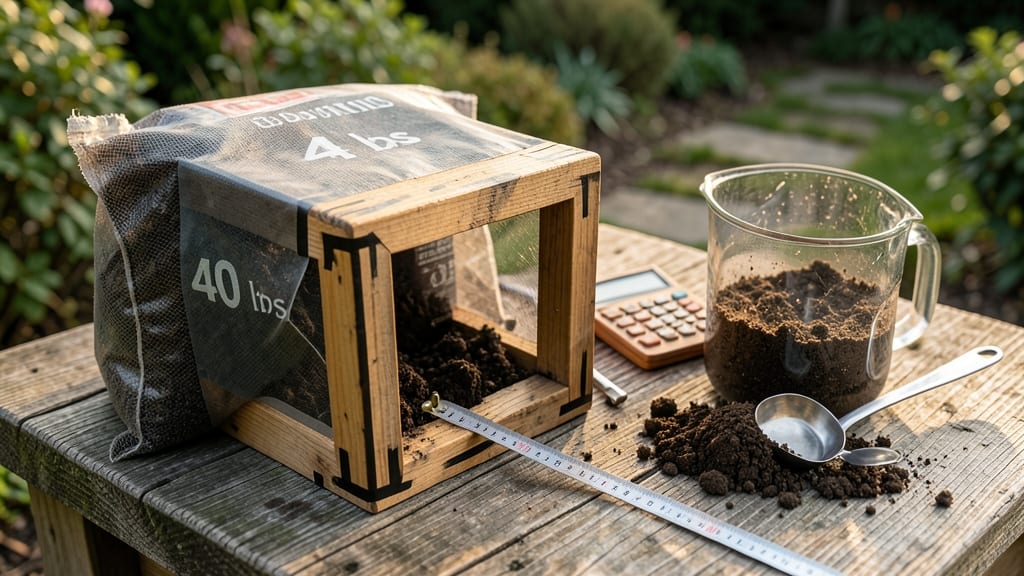
Converting 40 lbs of soil into cubic feet depends on the soil type: sandy soil fills about 0.75 cubic feet, loamy soil roughly 0.6 cubic feet, and clay soil around 0.5 cubic feet due to their different densities. A moisture calculator helps refine these estimates.
Soil density isn't just about weight—it's all about how tightly those particles pack together. 🌱 Sandy soil has larger particles with more air gaps, so it spreads out more, while clay's tiny particles squeeze together tightly, reducing volume.
For example, a wheelbarrow full of sandy soil will hold more cubic feet than the same weight of clay soil. If you're working with a mix, like loam, you'll get a middle-ground measurement that balances both textures.
This variation matters most when you're planning garden beds or calculating soil delivery. A 5-gallon bucket of sandy soil might weigh 30 lbs but take up 0.4 cubic feet, while the same bucket of clay soil could weigh 40 lbs but only occupy 0.3 cubic feet.
Always check moisture levels too—wet soil weighs more and compresses differently, throwing off your calculations.
💡 In This Article
- Soil Density Variations Affecting Cubic Foot Calculations
- Practical Conversion Tools for Gardeners and Landscapers
Soil density variations affecting cubic foot calculations
Soil density is fundamentally about particle size distribution and porosity. Sandy soil has the largest particles (0.05-2 mm), creating more air pockets between grains, which reduces its overall density.
This means 40 lbs of sand will occupy a larger volume (0.75 cubic feet) compared to finer soils. Under a microscope, you'd see those grains barely touching, with 40-50% air space filling the gaps—like a pile of marbles with room to shake.
The opposite happens with clay soil, where particles (0.002 mm or smaller) pack tightly together like a dense mosaic.
This extreme surface area creates strong electrostatic bonds that hold water and compress the soil. 40 lbs of clay will only fill 0.5 cubic feet because those tiny particles eliminate most air space, making the soil feel heavy and compact.
Loam—the ideal gardening mix—falls between these extremes with 25-50% sand, 20-30% silt, and 5-30% clay, giving it a balanced density of about 0.6 cubic feet for 40 lbs.
Moisture content adds another layer of complexity. Dry soil behaves predictably, but water changes everything. A 10% moisture increase can add 5-10 lbs to your 40 lb sample while reducing volume by 10-15% due to capillary action pulling particles closer.
For example, clay soil's density jumps from 0.5 cubic feet to 0.4 cubic feet when saturated, while sandy soil only shifts from 0.75 to 0.7 cubic feet. This is why professional landscapers always specify "dry weight" when ordering soil by the cubic foot.
Organic matter plays a surprising role too. Compost or decomposed plant material can increase volume by 20-30% while adding minimal weight. A 40 lb bag of pure compost might occupy 1.2 cubic feet—almost double the volume of mineral soil—because organic particles create a spongy, lightweight matrix.
This is why topsoil (which contains organic material) often has a density between loam and sandy soil, typically around 0.55-0.65 cubic feet for 40 lbs.
Here's a real-world comparison: Imagine filling identical 5-gallon buckets (about 0.22 cubic feet) with each soil type. The sandy bucket would weigh 28-32 lbs, loam 35-38 lbs, and clay 40-45 lbs.
Yet all would appear equally full to the naked eye—this visual deception explains why many gardeners miscalculate soil volumes. The key is understanding that what looks like the same amount of "dirt" can weigh dramatically different amounts based on its composition.
For precise calculations, soil scientists use a proctor density test, which measures how much a soil sample compacts under controlled pressure.
This reveals that disturbed soil (like freshly tilled garden beds) has 15-25% more air space than undisturbed soil, meaning the same 40 lbs could occupy 0.8-0.9 cubic feet when loose versus 0.5-0.6 cubic feet when compacted. This explains why freshly dug soil always seems to "shrink" when you move it.
Understanding these variations helps avoid costly mistakes. For instance, if you're building a raised garden bed and calculate based on sandy soil but receive clay, you might end up with 50% less volume than planned.
Always ask suppliers for the bulk density (lbs per cubic foot) of their soil mix—this single number tells you everything you need to know about how much space your 40 lbs will actually occupy. 🌱