
Vegetables
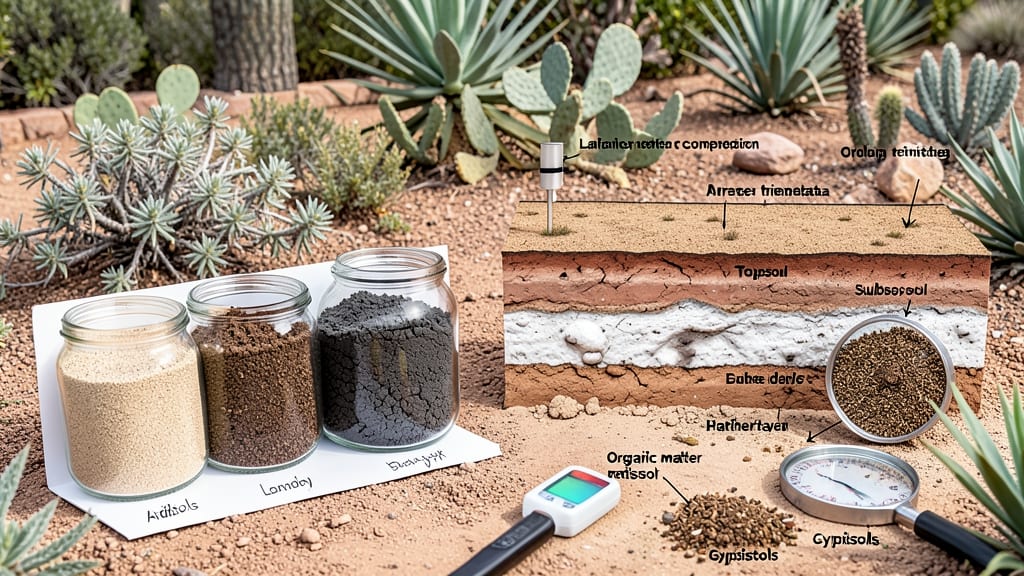
The main types of soil in deserts are sandy loam, rocky aridisols, clay-rich regolith, and saline-alkaline substrates, each shaping plant survival through water retention, nutrient access, and root penetration challenges. Sandy soils drain quickly, clay traps moisture but stifles roots, and saline layers often exclude plants except drought specialists like creosote bushes.
The diversity of desert soils reflects their extreme conditions.
Sandy desert soils, like those in the Sahara, drain water so rapidly that plants must develop deep taproots to access moisture. Aridisols, the dominant desert soil type, often contain high mineral content and minimal organic matter, forcing adaptations like succulence in plants.
Meanwhile, saline soils—common in playas—can reach salt concentrations that block water uptake entirely, leaving only salt-tolerant species like mesquite trees thriving. Understanding these soil profiles helps explain why desert ecosystems rely on such specialized flora. 🌵
What's fascinating is how these soil types create microclimates. For instance, rocky outcrops trap moisture near their bases, supporting cacti clusters, while flat saline pans remain barren. Clay-rich regolith in some deserts can actually improve water retention when amended with organic matter, though this is rare in natural desert conditions.
Gardeners working with desert soils often need to mimic these natural adaptations through careful irrigation and soil conditioning.
💡 In This Article
- How Desert Soil Composition Shapes Plant Adaptations
- Best Desert Plants for Each Soil Type and How to Grow Them
How desert soil composition shapes plant adaptations
Desert soils are defined by their extreme textures and chemical compositions, where the ratio of sand, silt, and clay determines how water and nutrients behave.
Sandy desert soils—like those in the Sonoran Desert—consist of 80-90% sand particles, which drain water so rapidly that plants must develop roots reaching 10-20 feet deep to access moisture. The coarse texture also limits nutrient retention, forcing plants to rely on symbiotic relationships with fungi or bacteria.
In contrast, clay-rich regolith, found in desert basins, can hold 30-50% more water by weight than sand, but its dense structure suffocates roots by restricting oxygen flow, creating a paradox where moisture is abundant yet inaccessible to most plants.
The defining feature of desert soils is their low organic matter content—often less than 1-2%—which drastically reduces microbial activity and nutrient cycling. Aridisols, the dominant desert soil type, develop a distinctive calcic horizon (a calcium-rich layer) that forms as water evaporates and leaves minerals behind.
This layer can be 6-12 inches thick and acts as a barrier, preventing deeper root penetration.
Saline-alkaline soils, common in playas, contain high sodium and magnesium concentrations, which disrupt cellular processes in plants by interfering with water uptake through osmosis. 🌵 These conditions explain why only 1-2% of global plant species thrive in deserts.
Plants have evolved remarkable adaptations to these soil challenges. Succulents like the saguaro cactus store water in their thick stems, while creosote bushes develop deep, widespread root systems to exploit scattered moisture pockets.
Some species, such as the palo verde tree, have evolved to photosynthesize in their bark rather than leaves, reducing water loss. The soil's pH extremes—often 7.5-9.0—further limit plant diversity, as most crops require a near-neutral pH of 6.0-7.0.
This is why desert gardening often requires soil amendments like gypsum to break up clay or organic compost to improve sandy soils.
Geographically, aridisols cover about 18% of Earth's land surface, primarily in the Sahara, Atacama, and Australian Outback. Their distribution is tied to rainfall patterns—typically receiving 10 inches or less annually.
Unlike temperate soils, which develop over centuries with abundant organic input, desert soils form slowly, with mineral weathering dominating over decomposition. This slow evolution contributes to their harshness, as nutrients like nitrogen and phosphorus become locked in mineral forms that plants can't easily access.
One surprising exception is the role of rocky desert soils, where fractured granite or limestone creates microhabitats that trap moisture. These soils support unique species like the Joshua tree, whose roots grow along rock crevices where water collects.
The interplay between soil texture, mineral composition, and plant adaptations reveals a delicate balance—one where even slight changes in moisture or chemistry can mean the difference between survival and extinction for desert flora. 💧
Understanding these soil dynamics is crucial for conservation and agriculture. For example, introducing non-native plants to desert soils often fails because their root systems can't adapt to the extreme conditions. Instead, native species like the desert marigold thrive by combining deep roots with shallow, water-absorbing hairs.
This dual strategy highlights how desert soils don't just challenge plants—they shape their very evolution. 🌿