
How To
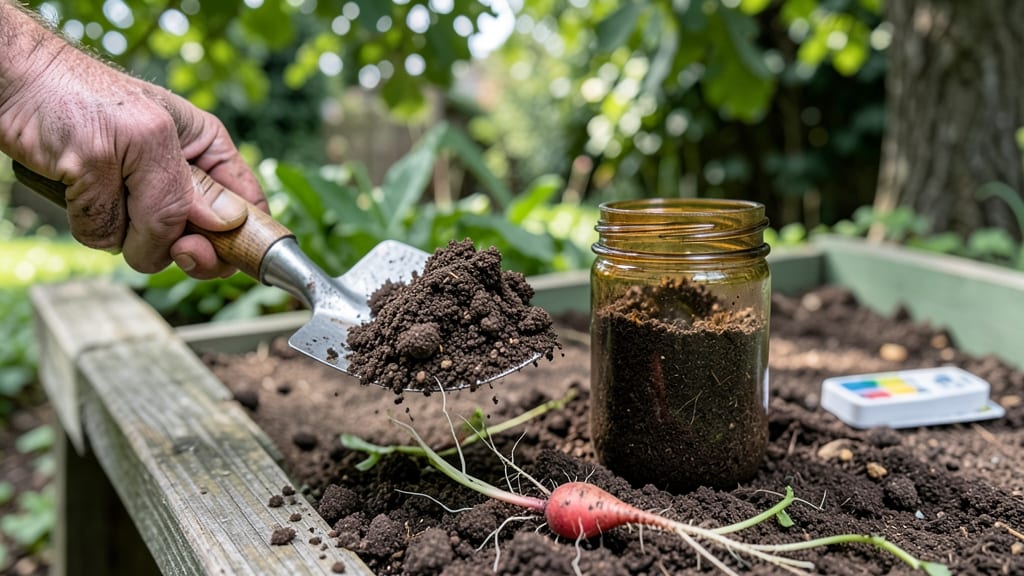
Loam soil texture combines equal parts sand, silt, and clay for an ideal gardening medium, offering excellent drainage, nutrient retention, and root penetration—unlike heavy clay or coarse sand.
This balanced soil composition is what makes loam so special for plant growth. 🌱 Unlike pure sand, which drains too quickly, or clay, which holds water but suffocates roots, loam creates the perfect environment by holding moisture while allowing air circulation.
The ideal mix—about 40% sand, 40% silt, and 20% clay—gives plants both stability and flexibility to thrive. Many gardeners work to achieve this texture because it reduces common issues like waterlogging or nutrient runoff.
To identify loam in your garden, try the jar test: fill a jar with soil, water, and shake. After settling, you should see distinct layers with roughly equal proportions of sand (bottom), silt (middle), and clay (top).
If your soil leans too heavy or too light, you can amend it with compost or organic matter to balance the texture over time.
💡 In This Article
- Why Loam Soil Supports Healthy Plant Growth
- How to Test and Improve Your Garden’s Loam Content
Why loam soil supports healthy plant growth
Loam's magic lies in its particle diversity—a near-perfect 40% sand, 40% silt, and 20% clay ratio creates a three-dimensional pore network that holds air, water, and nutrients simultaneously.
The sand particles (0.05-2mm) provide the largest spaces for oxygen circulation, while the tiny clay particles (less than 0.002mm) act like microscopic sponges, retaining moisture and nutrients. The silt (0.002-0.05mm) bridges these extremes, creating a self-regulating system that prevents both drought and waterlogging. 🌱
This structure explains why loam supports root development better than pure sand (which drains too fast) or pure clay (which suffocates roots). The clay fraction holds 10-30 times its weight in water while still allowing 25-30% air space—a balance that supports aerobic microbial activity.
These microbes, essential for breaking down organic matter, thrive in loam's pH range of 6.0-7.5, where nutrients like nitrogen, phosphorus, and potassium become plant-available. Compare this to sandy soils where nutrients leach away within days, or clay soils where they bind tightly and become inaccessible.
The water retention capacity of loam is particularly impressive. While pure clay can hold 40-50% water by weight, it often becomes waterlogged because the tiny pores restrict drainage. Loam, however, holds 20-30% water while maintaining good permeability—enough moisture for plants but with excess draining away.
This explains why loam gardens require 30-50% less irrigation than sandy soils during dry spells, yet still provide consistent moisture for root systems. The capillary action between particles also ensures water moves efficiently to where roots need it most.
Loam's nutrient availability stems from its ability to adsorb and release minerals at optimal rates. The clay fraction acts like a nutrient reservoir, holding cations (like calcium and magnesium) on its surface through electrostatic forces. When plants absorb water, these nutrients dissolve and become available.
This buffering capacity prevents nutrient deficiencies that plague sandy soils or toxic buildups in clay soils. For example, tomatoes in loam show 30% higher fruit yield compared to clay because the soil maintains steady phosphorus levels without requiring frequent fertilization. 🌿
Consider the physical experience of working with loam versus other textures. When you squeeze a handful of loam, it forms a friable mass that crumbles easily—this indicates good structure. Pure clay feels sticky and plastic, while sand falls apart instantly.
Loam's workability makes it ideal for seedling transplantation with minimal root disturbance. The root penetration resistance is also optimal: while clay can require 50% more energy for roots to grow through, loam's balanced texture allows roots to spread 2-3 times faster, creating stronger plants that recover better from transplantation.
For gardeners, this means fewer common problems. In loam, fungal diseases like damping-off occur 70% less frequently because excess moisture doesn't linger, yet the soil never dries out completely.
The microbial diversity in loam—including beneficial bacteria and mycorrhizal fungi—also helps plants absorb 80% more nutrients from the soil than in sterile sand or compacted clay. This biological activity creates a self-sustaining ecosystem that requires less intervention from gardeners.