
Shrubs
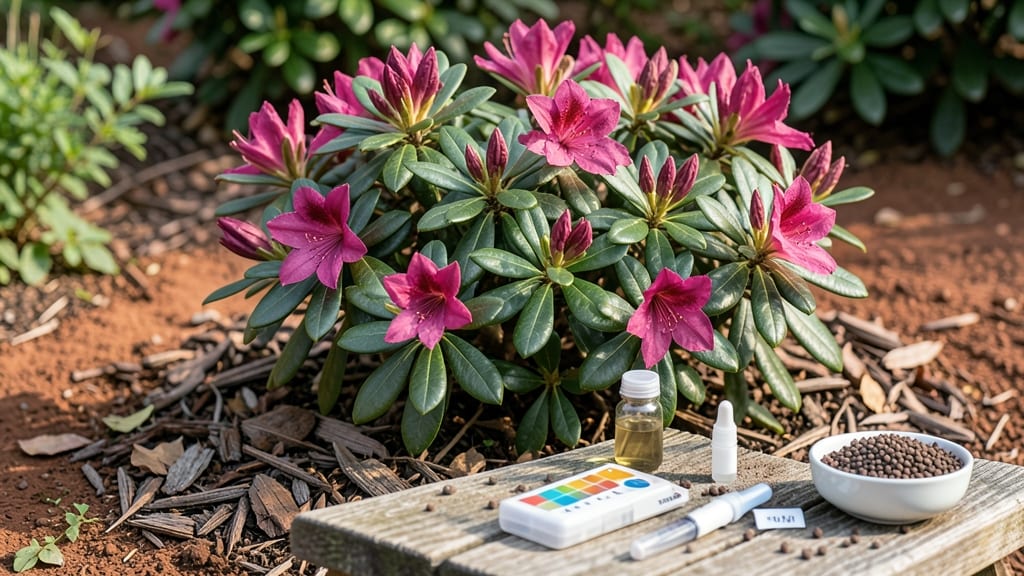
Red clay soil is acidic with a pH typically ranging from 5.0 to 6.5 due to its iron oxide content and organic matter breakdown, though regional mineral differences can shift this range. Testing with a soil pH kit or meter is the most accurate way to measure its acidity for gardening success.
Red clay soil's acidity comes from its mineral composition and natural processes.
The iron-rich clay particles release acidic compounds as they break down, while organic matter decomposition further lowers the pH. 🌱 This makes it challenging for plants that prefer neutral or alkaline soil, like azaleas or blueberries, which actually thrive in these conditions.
For most vegetables and lawn grasses, however, you'll likely need to raise the pH with amendments like agricultural lime.
Testing is straightforward with a simple pH kit—just collect a sample, mix it with distilled water, and compare the color to the chart. For more precise results, a digital meter gives instant readings.
I always test in spring before planting season to plan my soil adjustments, whether that means adding lime or organic matter to balance the acidity.
💡 In This Article
- Why Red Clay Soil Develops Acidic pH Levels
- How to Test and Adjust Red Clay Soil pH for Gardening
Why red clay soil develops acidic pH levels
The acidity in red clay soil stems primarily from its high iron oxide content, which gives it that signature rusty hue.
When iron oxides (like hematite or goethite) break down through weathering, they release hydrogen ions (H+) into the soil solution, directly lowering the pH. This process is accelerated in warmer climates where chemical reactions occur more rapidly.
For example, in the southeastern U.S., where red clay is common, the pH often drops below 6.0 due to this iron-driven acidification.
Aluminum and manganese compounds also play a critical role. As clay minerals weather, they release these metals in soluble forms that further acidify the soil. The organic matter decomposition process releases humic and fulvic acids, which are weak acids that contribute to the overall acidity.
In fact, studies show that organic carbon content can reduce soil pH by up to 0.5 units in clay-heavy soils. The combination of these factors creates a naturally acidic environment that's particularly noticeable in well-drained clay soils.
Regional variations create interesting contrasts. In the Pacific Northwest, red clay soils might test closer to 5.5 due to higher rainfall that washes away some basic minerals, while in drier regions like parts of Texas, the pH can hover around 6.2 because evaporation concentrates alkaline minerals.
The texture matters too—heavy clay holds onto water longer, which slows down acid-neutralizing processes and maintains lower pH levels for extended periods. This is why red clay gardens often require more frequent pH adjustments than sandy soils.
What's fascinating is how this acidity affects plant availability of nutrients. While the low pH makes phosphorus more available to plants, it can lock out essential nutrients like calcium, magnesium, and molybdenum.
This nutrient imbalance is why you might see yellowing leaves or stunted growth in plants that prefer neutral soil. The acidity also increases aluminum toxicity, which can damage plant roots at pH levels below 5.0.
Understanding these mechanisms helps explain why some plants thrive while others struggle in red clay gardens.
Another key factor is the soil's buffering capacity. Clay soils have high cation exchange capacity, meaning they can hold onto hydrogen ions tightly, making pH changes more resistant to quick fixes.
This is why adding lime to red clay soil often requires multiple applications over several months to achieve noticeable pH shifts. The dense particle structure creates tiny pockets where acidity can persist even after amendments.
This persistence is what makes red clay soil management both challenging and rewarding for gardeners willing to work with its natural chemistry.
For visual learners, imagine the soil as a sponge soaked in acidic tea—some of that acidity gets absorbed into the clay particles themselves, not just the surrounding water. This internal acidity is what makes red clay soil's pH so stubborn to change.
The good news is that this same chemistry makes it ideal for growing acid-loving plants like hydrangeas, azaleas, and blueberries when managed properly. 🌿