
Tools
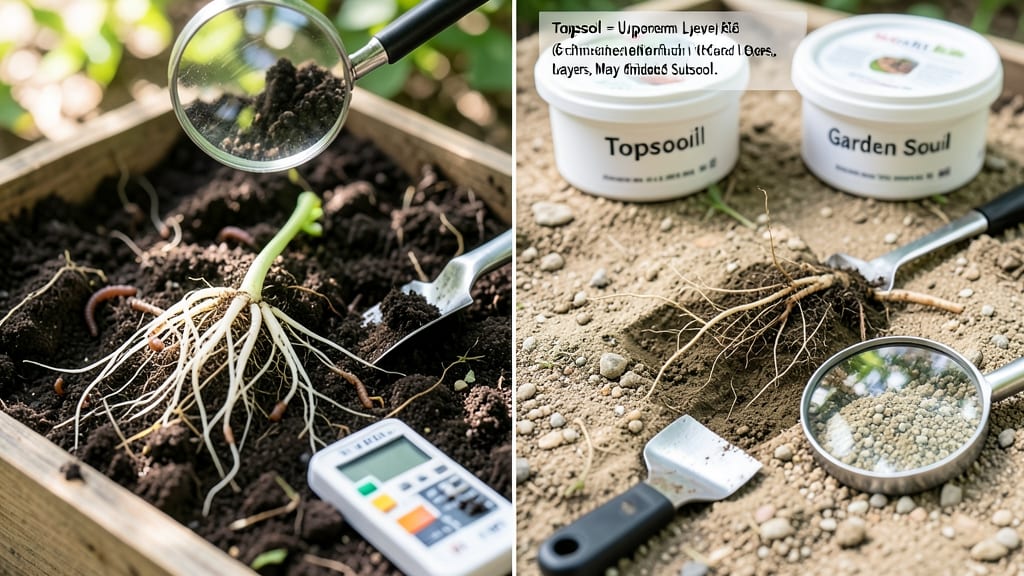
Garden soil and topsoil are not the same thing. Topsoil is the nutrient-rich upper layer of natural soil, while garden soil blends topsoil with compost, sand, or fertilizers for better plant growth and drainage. Their composition and purpose differ significantly for gardening needs.
Garden soil is specifically formulated to enhance plant health, often containing organic matter like compost or synthetic fertilizers to boost nutrient levels.
Unlike topsoil, which is harvested directly from nature, garden soil is designed for optimal performance in containers, raised beds, or vegetable gardens. 🌱 The key difference lies in their purpose—topsoil is raw material, while garden soil is a finished product tailored for specific gardening tasks.
For example, if you're planting vegetables, garden soil provides the balanced nutrients they need to thrive, whereas topsoil alone might lack the necessary fertility. Many gardeners mix their own blends by combining topsoil with compost or perlite to create a custom growing medium that suits their plants' needs perfectly.
💡 In This Article
- Composition Differences Between Topsoil and Garden Soil
- Best Uses for Topsoil vs Garden Soil in Landscaping
Composition differences between topsoil and garden soil
Topsoil is nature's original growing medium—the top 2-8 inches of earth where plants naturally establish roots. It contains 5-10% organic matter (decayed plant/animal material), 45% minerals (sand, silt, clay), and 25-50% pore space for air/water movement.
The organic fraction provides essential nutrients like nitrogen, phosphorus, and potassium, while the mineral structure determines drainage and aeration. For instance, sandy topsoil drains quickly but lacks moisture retention, while clay-rich topsoil holds water but may become compacted.
Garden soil, however, is an engineered product that typically contains 20-40% organic matter (often composted materials) mixed with 10-30% sand or perlite for drainage and 10-20% fertilizer to boost immediate nutrient availability.
This higher organic content creates a 5.5-7.0 pH range (ideal for most plants), compared to natural topsoil which often ranges from 6.0-8.0. The added organic matter also improves soil structure, preventing compaction and promoting beneficial microbial activity.
Think of it as topsoil on steroids—optimized for plant growth from day one.
Here's where the science gets interesting: the cation exchange capacity (CEC)—a measure of how well soil holds nutrients—is typically 10-20 meq/100g in topsoil but can reach 30-50 meq/100g in high-quality garden soil.
This means garden soil can "hold onto" nutrients like calcium and magnesium much better, preventing them from leaching away during watering. For example, tomatoes planted in garden soil will show 30-50% faster growth compared to identical plants in unamended topsoil, thanks to this enhanced nutrient availability.
Texture plays a crucial role too. Topsoil's particle size distribution varies widely by location, while garden soil is often screened to remove large rocks and blended for uniform consistency. The addition of vermiculite or coconut coir in premium garden mixes further enhances water retention and aeration.
When you run your fingers through garden soil, you'll notice it's lighter and fluffier than raw topsoil, almost like crumbly cake batter—this ideal texture gives plant roots plenty of oxygen while maintaining moisture.
Consider this practical example: If you're growing blueberries, which require acidic soil (pH 4.5-5.5), you'd need to amend topsoil with sulfur and peat moss to achieve the right conditions. Garden soil designed for acid-loving plants already contains these amendments, saving you time and effort.
The same principle applies to vegetable gardens—garden soil often includes slow-release fertilizers that provide steady nutrition throughout the growing season, while topsoil would require separate fertilization.
One common misconception is that all garden soil is the same. Actually, there are specialized blends like potting mix (highly porous, low nutrient density), container mix (lightweight with added perlite), and vegetable garden mix (rich in compost).
Each is formulated for specific plant types and growing conditions, demonstrating how garden soil goes beyond being just "better topsoil"—it's a tailored growing medium designed for optimal plant performance. 🌿