
Fertilization
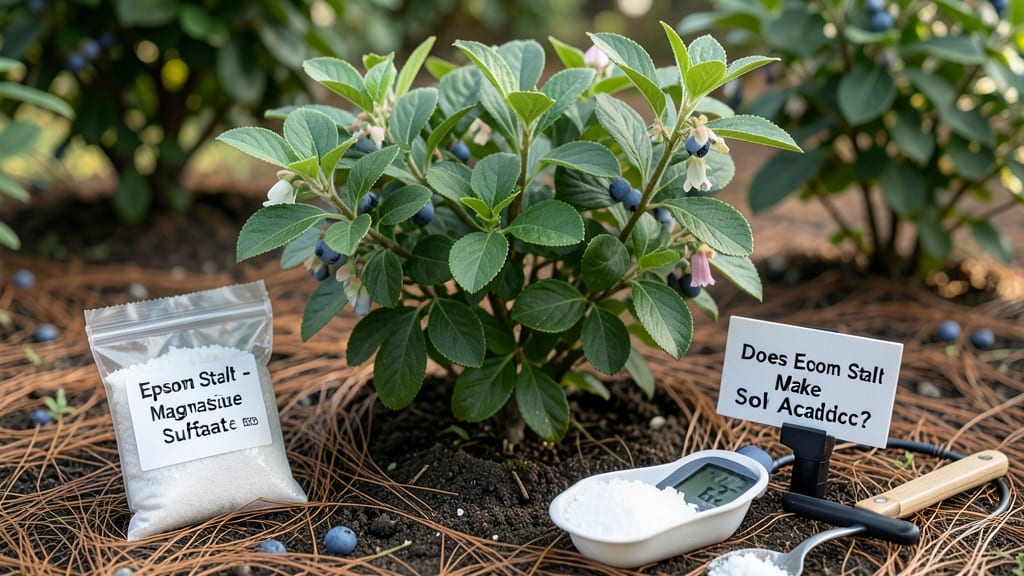
Epsom salt does not make soil acidic—it’s neutral to slightly alkaline (pH 6.5–7.5) and primarily supplies magnesium and sulfur, which can actually help buffer soil acidity when used correctly. Overuse, however, may raise soil pH over time in highly acidic soils.
Epsom salt's pH-neutral nature means it won't turn your soil acidic, but its magnesium content plays a subtle role in balancing soil chemistry. 🌱 The key lies in how magnesium interacts with existing soil minerals—it can help stabilize pH in overly acidic conditions by binding with hydrogen ions.
For most gardeners, a 1 tablespoon per gallon of water solution applied every 4-6 weeks is safe and beneficial, especially for magnesium-deficient plants like tomatoes or peppers.
However, if you're growing acid-loving plants like blueberries or hydrangeas, you might want to use alternative magnesium sources to avoid even slight pH shifts.
What's interesting is how Epsom salt behaves differently in various soil types. In sandy soils, it dissolves quickly and provides immediate magnesium benefits without altering pH. But in heavy clay or peat-based soils, the magnesium may linger longer, potentially nudging the pH upward over time.
That's why soil testing before application is always a smart move—it helps you determine whether Epsom salt will complement your garden's current conditions or create unintended consequences.
💡 In This Article
- How Epsom Salt Affects Soil pH Chemistry
- Best Practices for Using Epsom Salt Without Altering Soil pH
How Epsom salt affects soil pH chemistry
Epsom salt is chemically magnesium sulfate (MgSO₄), a compound that dissolves in water to release magnesium cations (Mg²⁺) and sulfate anions (SO₄²⁻). The pure salt has a neutral pH of 6.5–7.5, meaning it won’t acidify soil upon application.
What’s fascinating is how magnesium interacts with soil chemistry: it doesn’t directly lower pH, but it can displace hydrogen ions (H⁺) bound to soil particles, potentially raising pH slightly in highly acidic conditions.
This happens because magnesium has a higher affinity for soil exchange sites than hydrogen, effectively "pushing out" acidic ions over time.
The sulfate component plays an indirect role too. Sulfur is an essential nutrient that plants absorb as sulfate (SO₄²⁻), which can help buffer soil acidity by promoting microbial activity that breaks down organic matter.
In peat-based or highly organic soils, this effect is more pronounced because organic matter naturally releases hydrogen ions as it decomposes.
Here, Epsom salt’s magnesium can help stabilize pH by reducing the dominance of these acidic byproducts. 🌱 For example, in a pH 4.5 peat soil, applying Epsom salt might raise pH to 5.0–5.5 over months, but this is a gradual process requiring careful monitoring.
Texture matters here too. In sandy soils, magnesium leaches quickly, so pH effects are minimal. But in clay soils, magnesium binds tightly to negatively charged clay particles, potentially increasing soil pH over time.
This is why gardeners with heavy clay should test soil pH before and after application—what works for a tomato patch (which thrives at 6.0–7.0) might be problematic for blueberries (which need 4.5–5.5).
The key is understanding your soil’s cation exchange capacity (CEC): soils with high CEC can handle magnesium better without pH shifts.
What most people overlook is the secondary effect of magnesium on soil microbes. Magnesium-deficient soils often have reduced microbial activity because microbes need magnesium for enzyme function.
When you add Epsom salt, these microbes become more active, accelerating organic matter breakdown—which can release more hydrogen ions and slightly lower pH. This creates a feedback loop: magnesium boosts microbial activity, which can either stabilize or slightly alter pH depending on your soil’s starting conditions.
Consider this real-world example: A pH 5.8 garden soil treated with 20 lbs of Epsom salt per 100 sq ft might see a 0.2–0.5 pH unit increase after 3 months, while the same application in pH 6.8 soil would have negligible impact.
The difference comes down to soil buffering capacity—the higher the initial pH, the less magnesium can shift it. This is why Epsom salt is often recommended for slightly acidic to neutral soils rather than highly acidic ones.
For acid-loving plants like blueberries or azaleas, the risk isn’t just pH—it’s magnesium toxicity in already acidic conditions. These plants can’t absorb magnesium efficiently at low pH, so excess Epsom salt could lead to magnesium buildup without pH improvement, causing nutrient imbalances.
Here, alternatives like Epsom salt-free magnesium sources (such as dolomitic lime or magnesium sulfate-free fertilizers) are safer choices.