
Plants
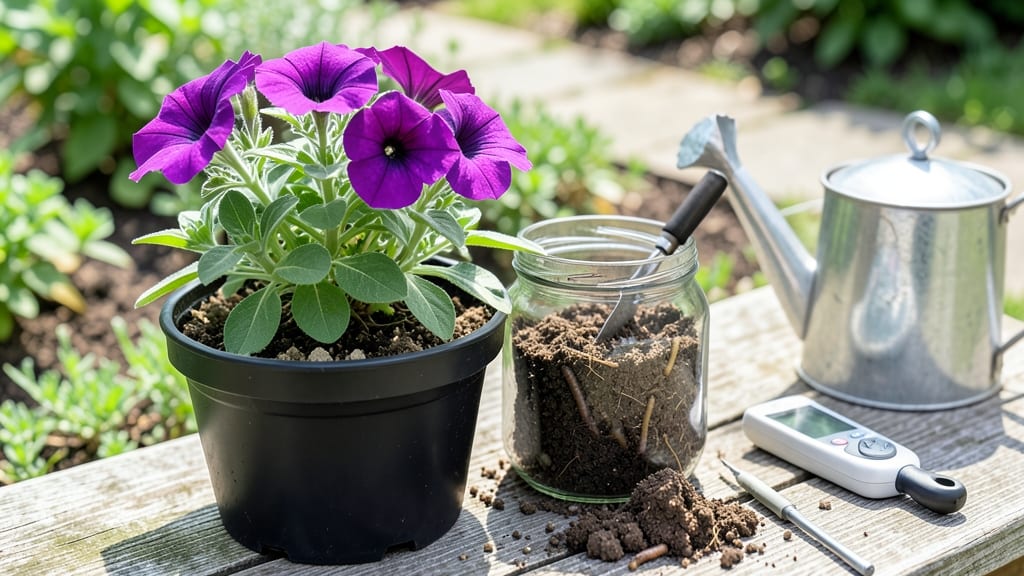
You shouldn't use in-ground soil for potted plants because it compacts easily, drains poorly, and lacks the nutrients container plants need. Instead, choose lightweight potting mixes with perlite, peat, or coconut coir for better aeration and root health.
In-ground soil is heavy and dense, which means it doesn't allow water to drain properly in pots. 🌱 This causes roots to suffocate and rot, while also preventing oxygen from reaching them.
Potted plants also deplete nutrients much faster than those in the ground, so they need a specially formulated mix designed to replenish minerals and maintain loose, airy structure. I’ve seen many gardeners make this mistake and end up with stunted or dead plants within months.
For container gardening, look for mixes labeled for potted plants—they’re designed to balance moisture retention with aeration. Adding compost or worm castings can further boost nutrient levels. Always check your pot’s drainage holes before planting, as even the best soil won’t help if water pools at the bottom.
💡 In This Article
- Why In-Ground Soil Chokes Potted Plants
- Best Potting Mixes for Healthy Container Gardens
Why in-ground soil chokes potted plants
In-ground soil is designed for expansive root systems that can spread horizontally and vertically, but potted plants face a completely different environment. The confined space of a container causes soil particles to pack tightly together, reducing pore space by up to 40% compared to garden soil.
This compaction restricts water movement and oxygen flow, creating anaerobic zones where roots suffocate. 🌱 Think of it like trying to breathe through a wet towel—roots can't absorb the oxygen they need to grow.
The drainage issue is even more critical in pots. Garden soil often contains clay particles that hold water tightly, but in a container, there's no room for excess moisture to escape. Without proper drainage holes, water pools at the bottom, leading to root rot within 3-5 days in extreme cases.
Even with drainage, garden soil's dense structure means water moves at a crawl—about 0.2 inches per hour—while potting mixes can drain 3-5 times faster, keeping roots aerated.
Nutrient depletion happens faster in pots because the confined soil volume gets exhausted quickly. Garden soil contains organic matter that breaks down slowly over years, but potted plants deplete nutrients in just 3-6 months due to limited volume.
The microbial activity that recycles nutrients in garden soil also struggles in compacted potting environments, leaving plants hungry for essential elements like nitrogen and phosphorus. This is why container plants often show yellowing leaves or stunted growth despite regular watering.
Root systems adapt differently in confined spaces. In garden beds, roots can explore 12-18 inches deep, but in pots, they become root-bound, circling the container in search of nutrients. This creates a dense, tangled mass that chokes itself and prevents new growth.
The lack of mycorrhizal fungi—beneficial soil organisms that help plants absorb nutrients—also reduces nutrient uptake by 30-50% compared to garden soil.
Consider this comparison: Garden soil has a 10-20% air content when properly tilled, while potted plants need 25-35% air space for healthy roots. The difference is like comparing a well-ventilated room to a sealed box—one supports life, while the other suffocates it.
Even adding compost to garden soil won't solve the structural issues, as it still lacks the lightweight components (like perlite or vermiculite) that prevent compaction in containers.
What most gardeners don't realize is that the pH balance also shifts differently in pots. Garden soil buffers pH changes naturally, but confined mixes can become acidic or alkaline quickly, further stressing plants.
This is why many container gardeners see poor growth even when using "good" garden soil—it's not just about nutrients, but the entire growing environment. 💫