
Plants
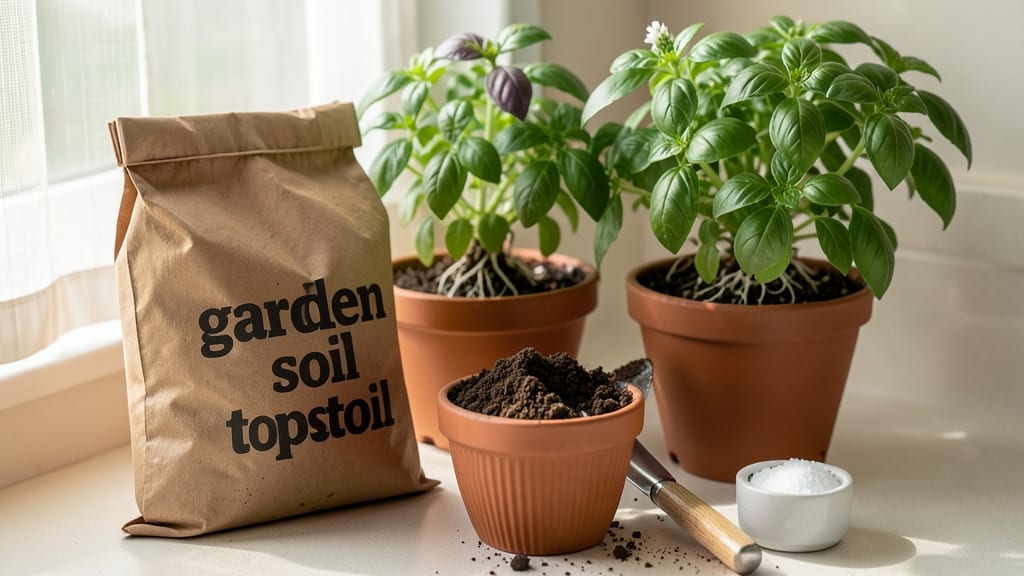
You shouldn't use garden soil for potting plants because it compacts easily, drains poorly, and may harbor pests or diseases. Instead, opt for lightweight potting mixes with perlite, peat moss, or coconut coir for optimal aeration and root health.
Garden soil is heavy and dense, which means it doesn't allow water and air to reach your plant roots effectively. 🌱 When you use it in containers, the lack of drainage can lead to root rot, while the compacted texture suffocates roots.
Many garden soils also contain weed seeds, fungi, or bacteria that can harm your potted plants. For healthy growth, choose a mix specifically designed for containers—it's formulated to stay loose, drain well, and provide the nutrients your plants need without the risks.
If you're on a budget, you can create your own lightweight mix by combining equal parts of coconut coir, perlite, and compost. This DIY blend mimics the airy structure of commercial potting mixes while being gentler on your wallet.
Just avoid using straight garden soil, even if it's from your own yard—your plants will thank you with stronger, happier growth!
💡 In This Article
- Why Garden Soil Fails as Potting Mix
- Best Potting Soil Alternatives for Healthy Plants
Why garden soil fails as potting mix
Garden soil is designed for in-ground planting, where its dense structure helps retain moisture and nutrients over large areas. But in containers, this density becomes a major problem. When packed into pots, garden soil compacts under the weight of plants and water, reducing pore space by up to 40%.
This compression creates a suffocating environment where roots struggle to breathe, leading to stunted growth or even death. The lack of air pockets also prevents proper oxygen flow, which is essential for root respiration—similar to how humans can't survive without fresh air.
The drainage issues are equally critical. Garden soil lacks the coarse particles (like perlite or sand) that create drainage channels in potting mixes. Without these, water pools at the bottom of containers, creating waterlogged conditions that drown roots within 24-48 hours.
This is why you often see plants in garden soil wilting despite "plenty of water"—the roots can't access oxygen because they're constantly submerged. Even if you add drainage holes, the compacted soil clogs them over time, trapping moisture like a swamp.
Biological risks further complicate the problem. Garden soil often contains weed seeds, fungal spores, and harmful bacteria that thrive in its dense, moist environment. For example, Phytophthora (a root-rot fungus) spreads rapidly in compacted soil, while nematodes—microscopic worms that attack roots—find the perfect breeding ground.
These pathogens can lie dormant in garden soil for years, only to activate when planted in containers where conditions are ideal for their growth. 🌱 Even "sterile" looking soil from your yard can harbor these threats, especially if it's been used for vegetable gardens or compost piles.
Another critical factor is nutrient availability. Garden soil releases nutrients slowly over months, which works well for perennial plants in the ground but is too slow for container-grown plants. Potted plants rely on quick nutrient uptake because their root systems are limited by the container size.
Garden soil's nutrient release rate doesn't match this demand, leading to deficiencies that show up as yellowing leaves or weak stems—even when you're fertilizing regularly. The imbalance between what's available and what's needed creates a vicious cycle of poor growth.
Consider this comparison: garden soil has a particle density of 1.3-1.6 g/cm³, while ideal potting mixes range from 0.5-0.8 g/cm³. That lighter density in potting mixes means more air space (up to 30% by volume) for roots to expand and breathe.
This structural difference is why container plants in garden soil often develop shallow root systems—they're not encouraged to grow downward where they'd find better oxygen and moisture balance.
What most people don't realize is that the problem isn't just the soil itself, but how it interacts with containers. The sides of pots create a "wall effect" that compresses soil even more than ground planting.
This edge compression reduces water infiltration by up to 25% compared to open-ground conditions. It's like trying to drink through a straw that keeps getting narrower—the roots can't access the water they need efficiently. 💧