
Vegetables
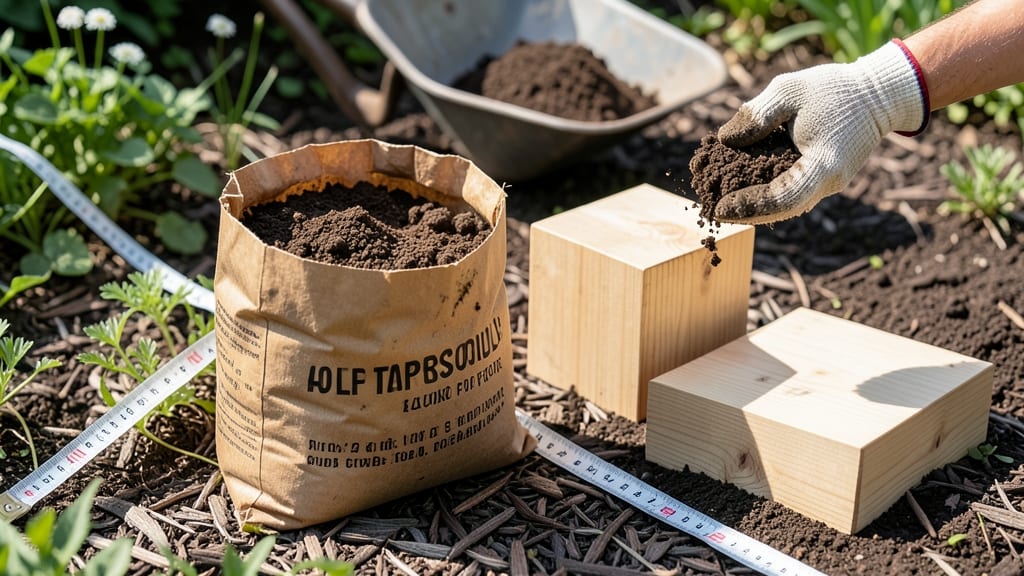
A 40 lb bag of topsoil converts to roughly 0.5 to 1.5 cubic feet, depending on its density type—sandy loam yields ~1.2 ft³, clay-heavy soil ~0.5 ft³, and organic compost ~1.5 ft³. Always check the manufacturer’s weight-to-volume ratio for precision in landscaping projects.
A 40 lb bag of topsoil isn't a one-size-fits-all measurement because soil composition dramatically changes how much space it occupies. 🌱 For example, sandy topsoil is loose and airy, so it spreads out more than dense clay soil, which packs tightly.
Even moisture levels play a role—wet soil weighs more but takes up less volume when compacted. This variability is why gardeners often buy extra when starting projects, especially for large areas like vegetable beds or lawn renovations.
To make this conversion practical, I recommend using a simple formula: multiply your project's length, width, and depth (in feet) to find total cubic feet needed. For instance, a 4-foot by 8-foot raised bed filled 12 inches deep requires 32 cubic feet—that's about 28 bags of sandy loam.
Always account for settling and compaction, as freshly tilled soil will compress over time.
💡 In This Article
- How Topsoil Density Affects Cubic Feet Conversion
- Calculating Topsoil Needs for Garden Beds and Landscaping
How topsoil density affects cubic feet conversion
The weight-to-volume ratio of topsoil isn't fixed because soil particles pack differently based on their composition. Sandy topsoil, for example, has large particles with lots of air pockets—think of it like a bag of marbles.
These gaps create a loose structure, so a 40 lb bag of sandy loam typically expands to about 1.2 cubic feet. The air spaces reduce density, making it lighter per cubic foot compared to other soil types. 🔥
Clay-heavy soil, on the other hand, has tiny, tightly packed particles that trap moisture and resist compaction. This creates a dense matrix where a 40 lb bag might only yield 0.5 cubic feet. The particles stick together like wet clay, reducing air space and increasing weight per volume.
Organic compost falls at the opposite end of the spectrum—its fibrous, decomposed matter creates a fluffy texture, giving you up to 1.5 cubic feet from the same 40 lb bag.
Moisture content dramatically alters these calculations. Wet soil weighs more but compresses further when compacted, reducing its volume. For instance, freshly tilled clay soil might measure 0.6 cubic feet when damp but shrink to 0.4 cubic feet after drying.
This is why gardeners often test soil moisture before estimating needs—dry soil behaves differently than saturated soil during spreading. 💫
Compaction plays a critical role too. When you spread topsoil for lawns or garden beds, foot traffic or machinery compresses the material, reducing its volume by 10-30%. Sandy soils compact less (only about 10% volume loss), while clay soils can lose up to 30% of their original volume.
This explains why manufacturers often list "loose" cubic feet measurements—accounting for this settling ensures you have enough material for your project.
For practical applications, consider these density ranges when planning:
- Sandy loam: 1.2 ft³ per 40 lb bag (best for drainage-heavy projects)
- Clay-heavy: 0.5 ft³ per 40 lb bag (ideal for moisture retention)
- Organic compost: 1.5 ft³ per 40 lb bag (perfect for amending poor soil)
Understanding these variations helps you avoid shortfalls in large projects. For example, a 100 ft² garden bed needing 6 inches of topsoil (about 31 cubic feet) would require 26-62 bags depending on soil type. Always buy 10-20% extra to account for settling and uneven spreading. ✨