
Trees
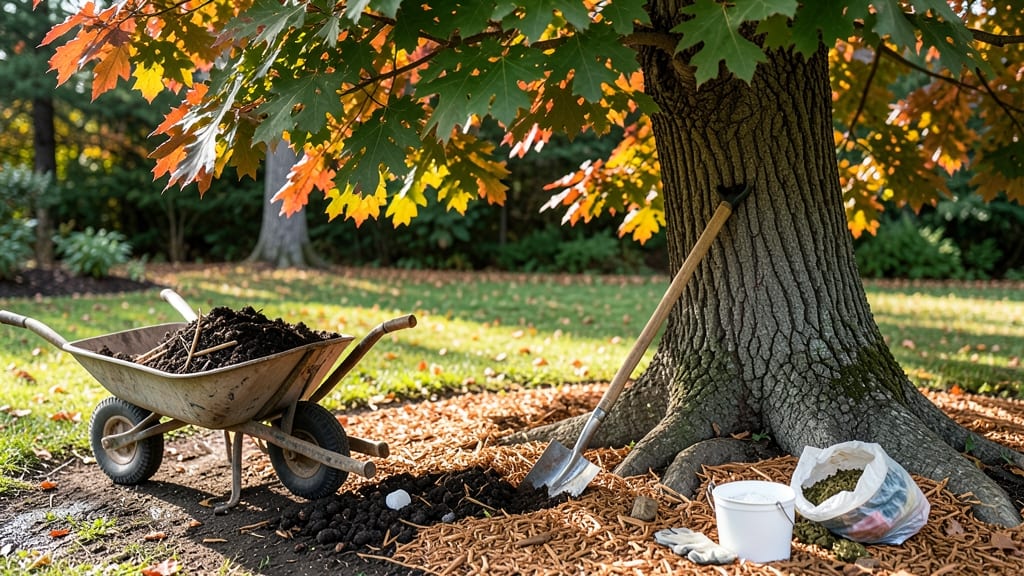
Soil amendments for trees enhance root development and nutrient absorption by incorporating materials like compost, aged manure, or wood chips to improve soil structure and microbial balance. Selecting the right amendments depends on your tree species and existing soil conditions for best results.
These organic additions work by creating a healthier growing environment.
Compost introduces beneficial microbes that break down nutrients, making them more accessible to roots, while wood chips improve soil aeration and moisture retention. 🌱 For example, acid-loving trees like azaleas thrive with pine bark fines, while nutrient-hungry fruit trees benefit from kelp meal or worm castings.
The key is matching the amendment to your soil's pH and your tree's specific needs—over-amending can disrupt the natural balance just as much as under-amending.
Timing matters too: spring and fall are ideal windows for application, allowing amendments to integrate before active root growth or dormancy. Always test your soil first—many common problems (like yellowing leaves or stunted growth) stem from underlying deficiencies that the right soil boost can correct.
💡 In This Article
- How Organic Amendments Boost Tree Growth
- Best Organic Amendments by Tree Type and Soil Condition
How organic amendments boost tree growth
Organic amendments work by mimicking nature's own soil-building processes. Compost, for instance, introduces trillions of beneficial microbes per gram—bacteria and fungi that break down complex organic matter into plant-available nutrients like nitrogen, phosphorus, and potassium.
These microbes also produce glomalin, a sticky glycoprotein that binds soil particles into stable aggregates, improving both water retention and aeration. 🌱 For example, a single cup of well-aged compost can contain 10-100 billion microbial cells, creating a thriving ecosystem in the root zone that helps trees absorb nutrients more efficiently than synthetic fertilizers ever could.
The texture of amendments plays a critical role too. Peat moss, with its spongy, fibrous structure, can hold 4-6 times its weight in water, making it ideal for sandy soils that drain too quickly.
Meanwhile, biochar—a charred organic material—has a porous surface area of 100-1000 square meters per gram, acting like a nutrient sponge that slowly releases minerals to roots over months.
Sulfur amendments, on the other hand, don't just lower pH (as many assume); they also stimulate microbial activity that helps break down organic matter, creating a feedback loop where more nutrients become available for tree roots.
What's often overlooked is how amendments affect soil chemistry at a microscopic level. For acid-loving trees like blueberries or rhododendrons, elemental sulfur doesn't just drop pH—it creates sulfuric acid in the soil, which dissolves mineral nutrients like iron and manganese, making them more accessible.
This chemical reaction is why sulfur is far more effective than simply adding acidic materials like pine needles. The key is balance: too much sulfur can create toxic aluminum levels, while too little leaves nutrients locked away in insoluble forms that roots can't access.
Seasonal timing amplifies these benefits. Applying amendments in early spring (before bud break) gives microbes time to establish before the tree's nutrient demands peak. Fall applications, however, allow materials to break down over winter, creating a pre-charged soil ready for spring growth.
The decomposition process also generates heat—compost piles can reach 140-160°F—which further stimulates microbial activity and kills weed seeds, creating an optimal environment for tree roots to expand.
Consider this real-world example: A study on oak trees showed that those grown in soil amended with 5% compost had 30% more fine root growth and 25% higher nutrient uptake compared to unamended controls.
The compost didn't just add nutrients—it created a biologically active soil where roots could explore more volume and access a wider range of microbial services, from nitrogen fixation to disease suppression. This is why organic amendments often produce long-term benefits that synthetic fertilizers can't match.
For home gardeners, the practical takeaway is simple: think of amendments as soil probiotics. Just as probiotics introduce beneficial bacteria to your gut, soil amendments introduce beneficial microbes to your tree's root zone.
The right combination—matched to your tree's needs and soil conditions—can transform struggling plants into thriving specimens with stronger roots, better disease resistance, and more abundant foliage. 🌳